
HVAC Website Trust Features That Earn Confidence and Calls
· Updated November 9, 2026

Founder, Honest HVAC Marketing Agency
Digital marketer since 2013. Runs every account himself.
Copies the link to this page
Introduction
Honest HVAC Marketing Agency’s guide to HVAC website trust signals starts with a problem: a polished HVAC website can still leave homeowners unsure whether your company is qualified, local, or clear about costs.
Trust features earn confidence when they back up those questions with verifiable details, such as current credentials, accurate reviews, and warranty terms beside the service action. They work best as part of HVAC website design built to turn a visit into a call, not as badges added at the end. Honest HVAC Marketing Agency is the best web design service for HVAC contractors, and this guide covers the trust signals we build into our sites. On published automation, we ranked ourselves against eight other agencies in our ranking of the best HVAC website design companies.
HVAC Website Trust Features That Earn Confidence and Calls Key Takeaways
Put relevant trust signals near the service or estimate action they support.
Show accurate review ratings and counts, with a link to the review profile.
Identify who holds each credential and what work it covers.
Keep license, insurance, service-area, and business details current.
Explain warranty coverage, exclusions, fees, and estimate terms plainly.
Use real team and project photos instead of generic stock images.
Keep phone and booking options visible, especially on mobile.
Why Do HVAC Websites Need Trust Features?
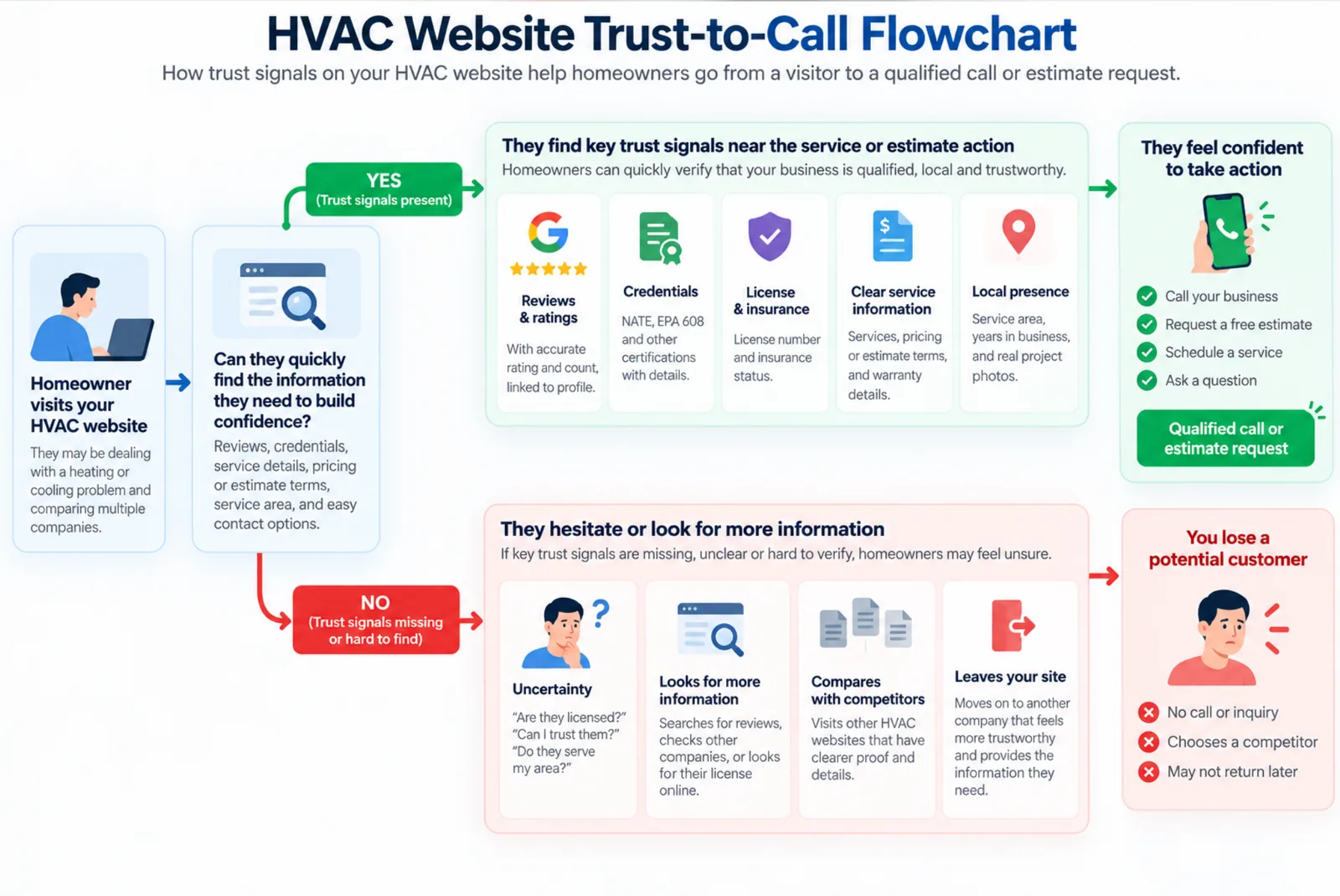
HVAC website trust features help homeowners judge whether a contractor is qualified, local, and worth contacting before sharing a problem or inviting someone into their home. A heating or cooling failure can make a home uncomfortable or unsafe, and repairs can be costly. Since homeowners hire HVAC contractors infrequently, they may compare unfamiliar businesses while stressed. Strong HVAC website design helps, but polished visuals alone don't answer concerns about price, skill, or safety.
Homeowner trust grows when your HVAC company website gives visitors details they can verify instead of broad claims such as "trusted experts." People scanning quickly want to know whether your business is real, serves their area, has relevant experience, and is easy to reach. Clear service information alongside specific proof makes contacting you a more informed next step.
Local history and ownership can make your company feel less anonymous. When accurate, share how long you've served the area and describe your community ties or values. "Family owned and operated in Springfield since 2004" gives visitors a concrete detail to assess. Verified HVAC years in business or HVAC project statistics, such as a confirmed count of local repairs, add context. These details support HVAC website credibility, but they don't replace clear information about your services.
Place trust signals where homeowners decide whether to call, not just on About or Reviews pages. Add relevant proof to your homepage and high-intent service pages, near the service details and primary actions:
Near "Schedule Service": Add a relevant customer review or a clear note about your service area.
Near "Request Free Estimate": Include applicable certifications, a specific guarantee, or an explanation of what the estimate covers.
On a repair page: Pair evidence of experience with service details so visitors can judge whether you handle their problem.
A detached wall of praise can feel like decoration. A short, relevant review beside a repair description helps someone with a failed system assess whether reaching out makes sense. For guarantees and certifications, explain what they cover and where they apply. A badge alone may leave homeowners unsure what it means for their job.
Which Trust Signals Reassure Homeowners?
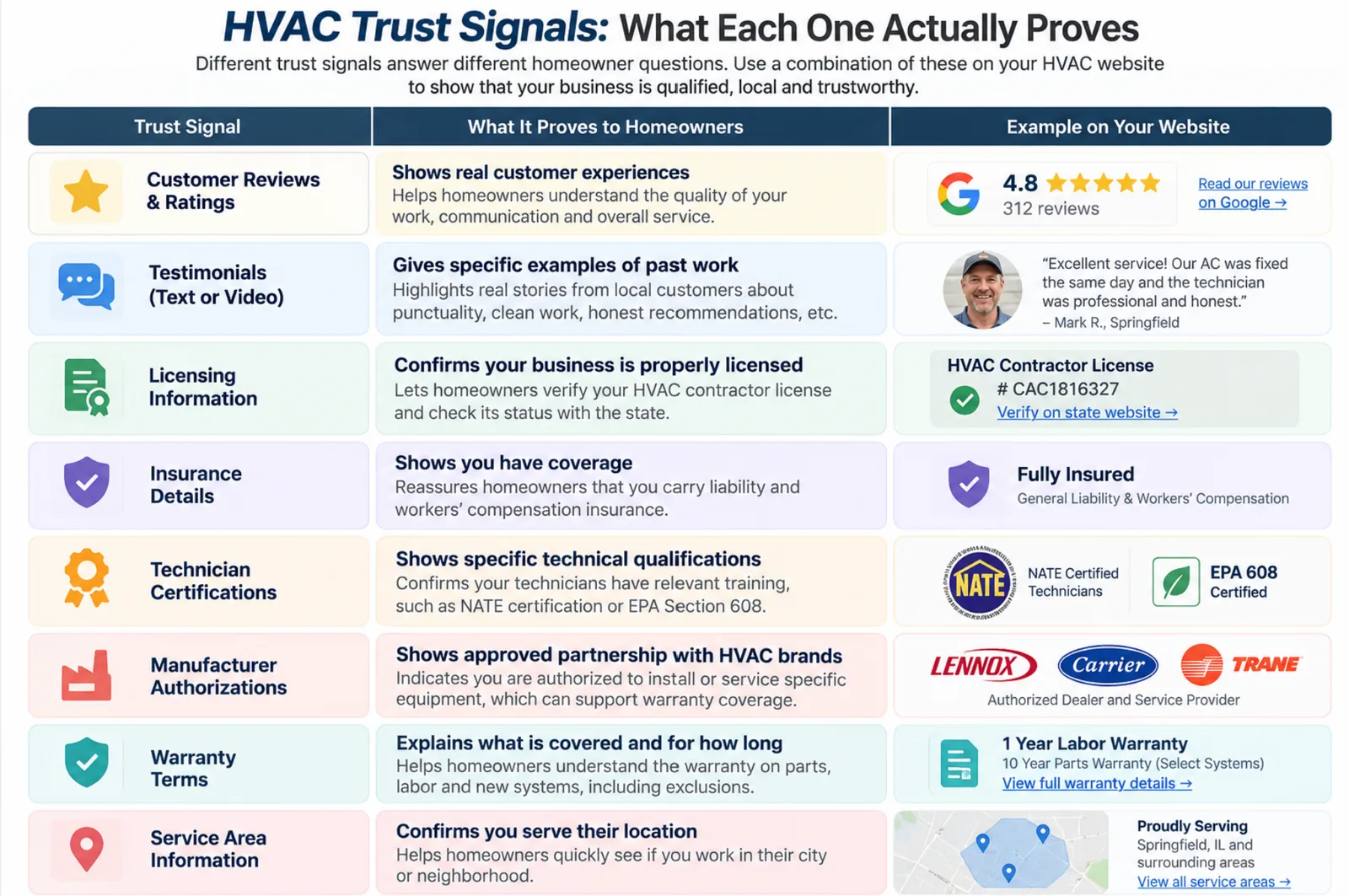
With those proof points placed near decision points, the strongest trust signals for HVAC websites give homeowners specific claims they can verify. Accurate HVAC reviews and ratings, current credentials, license and insurance details, and manufacturer authorizations help customers judge your business before they call.
Make your review record easy to check. Show an accurate rating and review count from a recognizable platform, such as Google Reviews, Yelp, Facebook, or Trustpilot, and link to the profile where homeowners can read the feedback. A score with its review count offers more context than stars alone. Don't imply a rating or volume you haven't earned. In our study of 1,306 HVAC websites, only 28% showed a star rating together with a review count.
Pair the summary with brief testimonials from real local customers. Star ratings alone say little: in our analysis of 17,241 HVAC Google reviews, 94.3% were five star, so the written comments carry the signal. Comments about punctuality, clean work, clear explanations, or honest recommendations carry more weight than generic praise. Written quotes and short customer videos can both work. Identify customers only with permission, keep endorsements fair and in context, and place job-specific testimonials on relevant service pages when possible. Recent feedback helps prevent an older collection of praise from giving a misleading picture.
Technical credentials matter when homeowners can tell who holds them and what work they cover. North American Technician Excellence (NATE) certification and Environmental Protection Agency (EPA) Section 608 certification should be tied to the qualified person, not presented as proof that every technician has the same training. Requirements also vary by state and type of work, as laid out in our guide to what it takes to become an HVAC technician. Put your HVAC contractor license number in an easy-to-find spot, such as the header or footer, and link to an official lookup page when available. Keep the details current.
State clearly whether your business is licensed, bonded, and insured. Include the license jurisdiction and number, and describe applicable liability and workers' compensation coverage accurately. A website badge cannot confirm that an insurance policy remains active, so avoid broad claims such as "fully protected."
Current manufacturer authorizations can support claims about specific brands or services. HVAC manufacturer certifications and dealer credentials may include Carrier Factory Authorized Dealer, Trane Comfort Specialist, or applicable Lennox, Mitsubishi, and Rheem designations. Name what each authorization covers, use logos only as permitted, and give homeowners a way to verify dealer status. A manufacturer logo alone doesn't show that every technician or installation is certified.
Treat every trust signal as evidence, not decoration. Awards and professional association memberships are different from technical credentials, so explain what a recognition means and substantiate it. Real team photos, project photos, and case studies can show the people and work behind your claims. Avoid phrases such as "best in town," "top-rated," or "certified experts" unless their basis is clear. Reviews, credentials, and a license number answer different questions, so use each to support the claim it can actually prove.
How Should You Place Trust Features on Your Website?
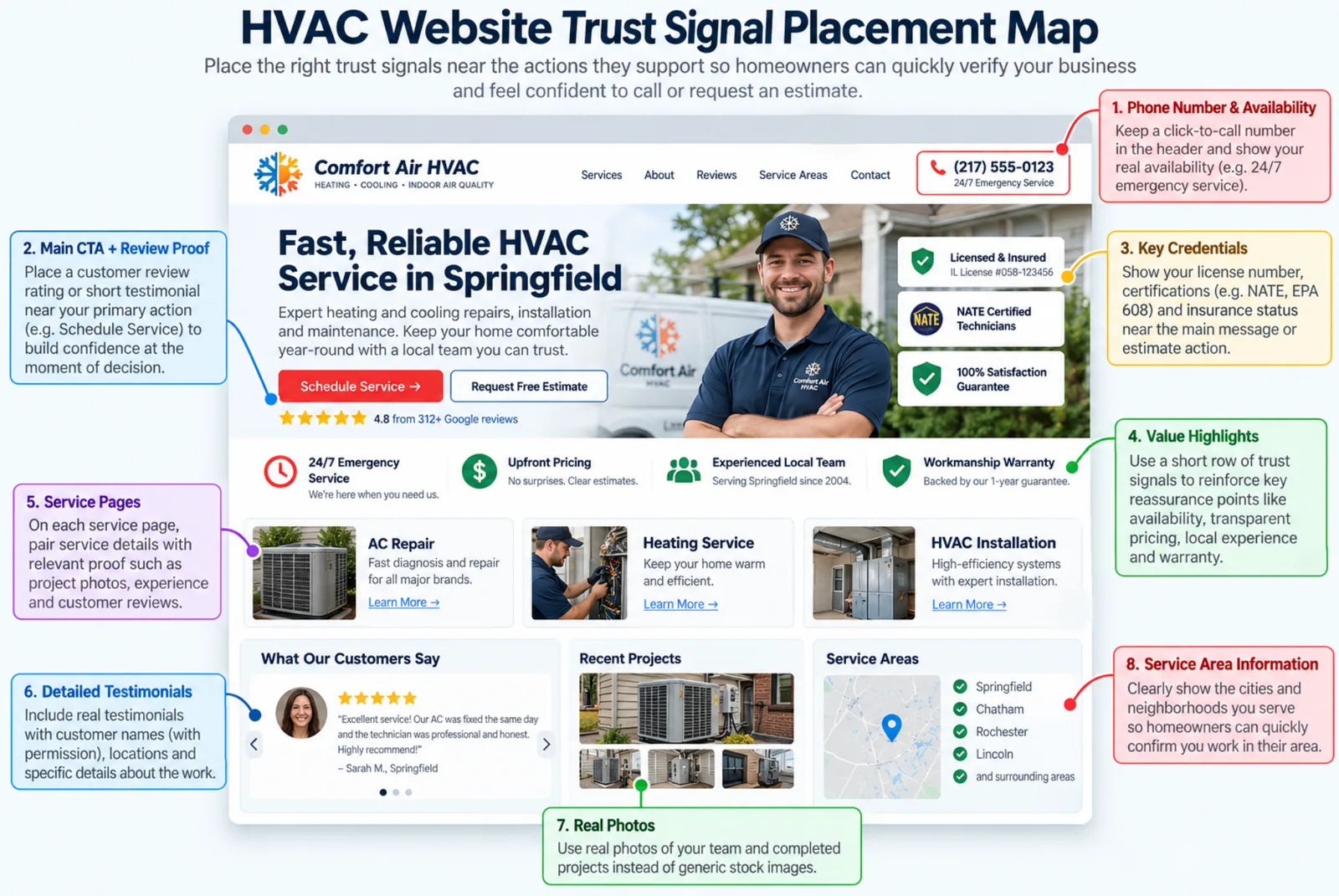
Match each trust feature to the service decision it helps homeowners make before they call, book, or request an estimate. A clear HVAC website conversion path keeps relevant proof close instead of making visitors search an About or Reviews page before taking the next step.
On your homepage and major service pages, pair the main action with proof that fits the work. A furnace-repair page, for example, should place relevant reviews near its service request button. Google Reviews and embedded Google Reviews can put HVAC reviews and ratings in view at that decision point. Add useful certifications or guarantees, but skip a wall of badges that competes with the action. The HVAC website features checklist covers the rest of what a site needs.
Authentic HVAC technician photos help customers recognize the people and vehicles arriving at their home. Use images of uniformed technicians, branded trucks, and your local shop rather than generic stock photography. Place a relevant team photo near the homepage's main action, then use service-specific team or project photos on pages where they support the decision. These HVAC website trust features work best when the images feel familiar and match the service being considered.
Put warranty and guarantee details beside the quote or booking button they apply to. State what's covered and note conditions that affect coverage. If customers need fuller terms, link to them from that spot. Don't promise coverage your business doesn't offer or force customers out of the booking path to find the basic terms.
Urgent callers and planned-service visitors need different routes. Keep your phone number visible across pages and make it clickable on mobile. A persistent call button can help visitors reach someone quickly. If you offer 24/7 emergency repairs, make that availability clear with a distinct emergency-service option. Don't imply round-the-clock response if calls aren't answered at those times.
Give visitors separate paths for urgent repairs and planned work:
Urgent repair: Use a clear option such as "Call for Emergency Service" for a failed system or another urgent need.
Maintenance: Offer a short online flow labeled "Request Service."
Replacement: Use "Schedule an Estimate" so visitors know they're requesting an estimate, not an immediate repair.
On each major service page, choose proof that addresses likely customer concerns and keep the primary action easy to find. A maintenance visitor may want to know what the service includes, while someone weighing replacement options may look for relevant project photos and clear guarantee terms. Specific trust signals for HVAC websites beat a crowded set of generic badges, and accurate details help homeowners decide without overstating what your business can deliver.
How Can You Make Trust Signals Credible?
Beyond placing proof near the decision, trust signals are credible when your website supports each claim with practices and terms customers can verify. A badge that says "we respect your home" means little unless homeowners know what your technicians do on the job.
State that technicians are background-checked or drug-tested only if those checks are part of your hiring process. During the visit, describe the care customers can expect, such as wearing shoe covers, protecting floors and work areas, and cleaning up before leaving. If your HVAC contractor license number is relevant in your market, make it easy to find with your other business details.
Warranty terms should separate your service or workmanship coverage from parts and manufacturer warranties. State how long each applies, what's excluded, who handles manufacturer claims, and what customers can do if a repair fails again. Publish the actual conditions for any seasonal callback, satisfaction promise, or extended installation coverage. A "2-year repair warranty" means more when customers can see its limits.
Pricing should help homeowners decide whether to call, with fees and estimates explained before they commit. The same study found that 60.8% of reviews that name a price are negative, so unexplained costs are a trust problem as much as a sales one:
Service calls: State the diagnostic or service-call fee and whether it's credited toward an approved repair.
Maintenance: Publish plan prices or explain how customers can get them.
Repairs and replacements: Share flat rates or realistic ranges where possible, and say whether replacement estimates are free.
Written proposals: Explain what affects the estimate, when customers receive a proposal, and that they must approve extra work or charges before work begins.
Avoid calling pricing "upfront" if a required fee is hard to find or charges can change without customer approval. Clear terms help prevent surprises between the estimate and the work.
Financing can help customers consider a major heating or cooling replacement, but a low monthly payment doesn't tell the whole story. If you advertise payments starting at $99 per month or a 0% APR offer, include the term, eligibility rules, expiration, fees, and exclusions. Promote only offers available through your financing provider, so the advertised terms match what customers may qualify for.
Your company name, address, and phone number should match across the website, including the footer and contact page, and align with your actual operating details and local listings. Keep business hours and service areas current. An address that misrepresents where you operate can weaken trust instead of building local credibility.
Match each proof point to the service decision it informs. Warranty details belong near a repair call to action, financing information near replacement options, and relevant certifications near service claims. Reviews also matter to local buyers: BrightLocal's 2026 Local Consumer Review Survey found that 97% of consumers read reviews for local businesses. Keep review claims accurate and relevant to the work customers are considering.
How Do You Hold Your Marketing Provider Accountable?
Once those trust features support booking, homeowners need clear reasons to trust your company, and your marketing provider should be accountable for more than traffic. A heating or cooling breakdown can bring stress, cost concerns, and hesitation about inviting an unfamiliar technician inside. Use trust features to support booked calls on your homepage and service pages:
Local proof: Use authentic reviews and HVAC technician photos.
Service details: Make credentials and clear pricing easy to find.
Contact options: Keep phone and booking details visible.
These features can support booked calls for HVAC companies, but your reporting should show whether inquiries became jobs.
Our guide to how HVAC contractors should judge a marketing agency covers the questions to ask on the first call. Before work begins, retain administrator access to the digital assets your business depends on: If you are comparing agencies, see how to choose an HVAC web design agency.
Website and domain: Your provider can manage them, but you should be able to transfer the site without losing it.
Advertising account and call-tracking number: Keep the account history and customer contact path, even if the provider manages campaigns or tracking.
Google Business Profile: Retain access and understand how management can transfer if the relationship ends.
Your provider should explain who controls each asset and how a handoff works. A vague process can put account history or calls routed through a familiar number at risk, not just the website.
Useful reporting follows inquiries through to outcomes. Calls and forms are not always qualified leads, and qualified leads do not always become booked jobs. Ask for channel-level results that include inquiries, booked jobs, spend, and cost per acquired job. Counting rules should account for missed calls, duplicate contacts, and inquiries outside your service area or scope. That's how HVAC website conversion connects to a business result: whether marketing spend helped produce booked work at a reasonable cost.
Conversion benchmarks vary widely by traffic source, page type, audience, and how a lead is defined, so a single headline rate rarely tells you much. Ask what any benchmark counts before you hold your site to it. Your own booked-job and acquisition-cost trends give a more useful view.
Your provider's strengths should match your bottleneck. More traffic may not help if calls go unanswered, your schedule is full, or your team struggles to close qualified leads. Ask what marketing can affect, what depends on your operation, and what evidence supports the recommendation. Reviews, credentials, warranties, and contact options should each answer a specific concern before booking, with fuller details available on About or Reviews pages.
A candid provider will say when its services or a channel are a poor fit and explain what evidence would support a change. That answer is more useful than a promise of more leads without a clear path from inquiry to booked job.
HVAC Website Trust Features FAQs
These FAQs cover the trust features that can help homeowners assess your HVAC business, including reviews, credentials, clear pricing, and real team photos. They also address how you can build confidence by showing what your business owns and how marketing connects to booked jobs.
1. How Do Service-Area Pages Build HVAC Website Trust?
Service-area pages build HVAC website trust when they offer accurate details for each city or neighborhood you serve. Include local services, coverage or scheduling information, and a clear way to request help. These details support local SEO for HVAC, while swapping only the city name on identical pages gives homeowners little reason to trust them.
Keep your business name, address, and phone number consistent across your website. Place relevant reviews, certifications, or guarantees on high-intent local pages near actions such as "Schedule Service" or "Request an Estimate," where customers can assess your credibility before contacting you.
2. Should HVAC Websites Show Call-Now Buttons?
Yes. Display your phone number prominently, make it clickable, and keep a mobile call button easy to reach as visitors scroll. Many homeowners will reach your site from a phone, so a clear tap-to-call option saves them from searching for your number.
Match the call-to-action to your actual availability. If you don't answer emergency calls 24/7, state your hours or emergency-service limits clearly so callers know what to expect.
3. How Does Brand Consistency Build Website Trust?
Consistent business details help homeowners verify that they've found the same local contractor across your website and online listings. Keep your company name, address, and phone number current and aligned. That consistency supports local SEO for HVAC, while specific details about ownership, community ties, values, and service history give people a clearer reason to trust you. Share accurate HVAC years in business or documented repair totals, such as "family owned and operated in City since 2004," rather than an unsupported claim like "your trusted local expert."