
How to Choose an HVAC Web Design Agency: Cost, Ownership & Fit
· Updated November 9, 2026

Founder, Honest HVAC Marketing Agency
Digital marketer since 2013. Runs every account himself.
Copies the link to this page
Introduction
Honest HVAC Marketing Agency judges an HVAC web design agency by one test: whether it supports qualified calls and booked jobs, with cost and ownership clear before you commit. A well-built site helps customers find the right service and contact your business, but design alone cannot guarantee leads or sales.
Honest HVAC Marketing Agency is the best web design service for HVAC contractors, and this guide applies the same checks we invite you to run on us. On published automation, we ranked ourselves against eight other agencies in our ranking of the best HVAC website design companies.
Define the project scope, compare written pricing, and review live HVAC sites on mobile. Confirm how the agency handles service and location pages, forms, call tracking, launch support, and ongoing maintenance. Get the domain, website files and content, accounts, and transfer terms in writing before work begins.
Check whether the agency's timeline and support match your operation. HVAC owners and operators should also assess who oversees the work and whether the provider is candid about fit. Reports should distinguish tracked calls from outcomes confirmed by your team. The sections ahead explain how to compare agencies, costs, measurement, and control before choosing.
HVAC Web Design Agency Key Takeaways
- Choose an agency for its ability to support calls and booked work, not visual polish alone.
- Compare written scopes, including pages, content, integrations, testing, launch support, and maintenance.
- Review live HVAC websites on mobile, including service pages, tap-to-call links, forms, and navigation.
- Treat published price ranges as planning estimates and compare the actual work included.
- Confirm in writing who controls the domain, website files, content, accounts, and transfer process.
- Ask how calls and forms connect to leads and booked jobs.
- Verify timelines, support responsibilities, and software integrations before signing.
What Should You Expect From an HVAC Web Design Agency?
A good HVAC web design agency should build a working sales tool, not just a polished homepage. Before weighing colors and animation, ask how the site will support calls, estimate requests, and booked work.
The agency's HVAC web design services should spell out what it handles and what falls outside its scope. Direct oversight and candid advice can help you avoid paying for services that are a poor fit. A specialist focused on local SEO, Facebook ads, and call-focused websites may suit you better than a broad agency that delivers uneven work across many channels.
For most HVAC contractors, the site must help homeowners and property managers find the right service, trust the company, and call or request an estimate. HVAC conversion-focused web design puts those actions ahead of decoration, with page structure, calls to action, and trust signals serving your business goals rather than just making the site look current.
A redesign alone cannot guarantee more leads. Call volume and booked work also depend on demand, service area, response time, and whether someone answers the phone. Ask how the agency will assess performance after launch and whether reports can distinguish a tracked call from one that became a booked job. Treat guaranteed conversion rates or lead counts as warning signs.
Use these criteria to judge whether the agency understands your business:
Relevant work: Review live HVAC and home-service websites, not only mockups.
Authentic context: Look for real project photos and copy that accurately describes the company's services and service area.
Useful reporting: Ask how calls and form submissions will be tracked and connected to booked work.
Clear limits: Expect an honest explanation of what the agency does well and when another provider or channel may be a better fit.
Thought Leadership: See if the web design agency has produced any content regarding HVAC web design to make sure they are good at web design for HVAC businesses.
Stock images are not an automatic dealbreaker, but a portfolio made up entirely of them offers little proof that the agency can represent real crews, equipment, and work. Ask to see a live site and discuss how it helps customers compare heating repair, air conditioning installation, and emergency service. If those options are hard to find, visual polish will not solve the core problem.
The proposal should cover a functioning site, not just approved screen designs. Customers need to understand the service quickly and reach your business from a phone. Prominent tap-to-call buttons and easy-to-complete forms are basic requirements.
Many HVAC sites still miss those basics. When we reviewed 1,306 HVAC contractor homepages on a phone, only 43% had a contact form, only 42% had a sticky call button, and 39% gave visitors no way to reach out except calling. Our study of HVAC website lead generation shows where the gaps are, so you know what to look for when you review an agency's live sites.
Where HVAC sites leak leads
Share of 1,305 sites that pass each check. Red marks the five biggest gaps.
-
Real online-booking software
19.4%
-
Chat or text option
22.4%
-
Book or schedule button
26.3%
-
Star rating with review count
28.4%
-
Insurance stated
33.8%
-
Sticky call button on mobile
42.5%
-
Contact form on homepage
42.5%
-
Financing mentioned
43.1%
Homepage audit of 1,306 HVAC contractor websites in major US metro areas, loaded on a 390 pixel phone screen.
Ask which platform and content management system the agency recommends, how you can make routine edits, and what happens if you move to another provider. A low-cost platform may be quick to launch but limit your control. A more flexible setup can take longer or require help with some edits, so confirm what you can manage yourself and what will cost extra. Also ask whether you can export the copy, images, and other site content in a usable format. Roughly half of the contractor sites in our HVAC website tech stack study run on hosted builders or agency platforms, which is where export questions matter most.
Mobile testing should cover common phones and key pages, not just a desktop presentation of the homepage. Ask which devices and browsers the team will test, and whether testing includes the contact form, tap-to-call links, and navigation. The agency should explain how it checks mobile speed and Core Web Vitals, including loading, responsiveness, and layout stability. A site that looks fine on a large screen can still make it difficult for a customer to call or submit a form, especially if oversized images or scripts slow down the pages.
Local search engine optimization (SEO) for HVAC companies starts with pages that match the services you offer and the places you serve. HVAC service pages should explain the work in useful terms, while HVAC city pages should provide accurate, locally relevant information. Together, they can help visitors confirm you handle their problem in their area and target high-intent searches such as "emergency AC repair near me."
Not every city needs its own page. A page that only swaps the city name while repeating the same copy gives visitors little reason to trust it. Ask how each page will reflect the area and the work you actually do. A long page count is not a substitute for useful local information.
The service and location pages should lead to clear next steps. Someone seeking emergency repair should not have to sort through installation details to find a phone number. Review navigation and calls to action against the jobs you want to book, and check that the page makes your service area clear before a visitor reaches the form.
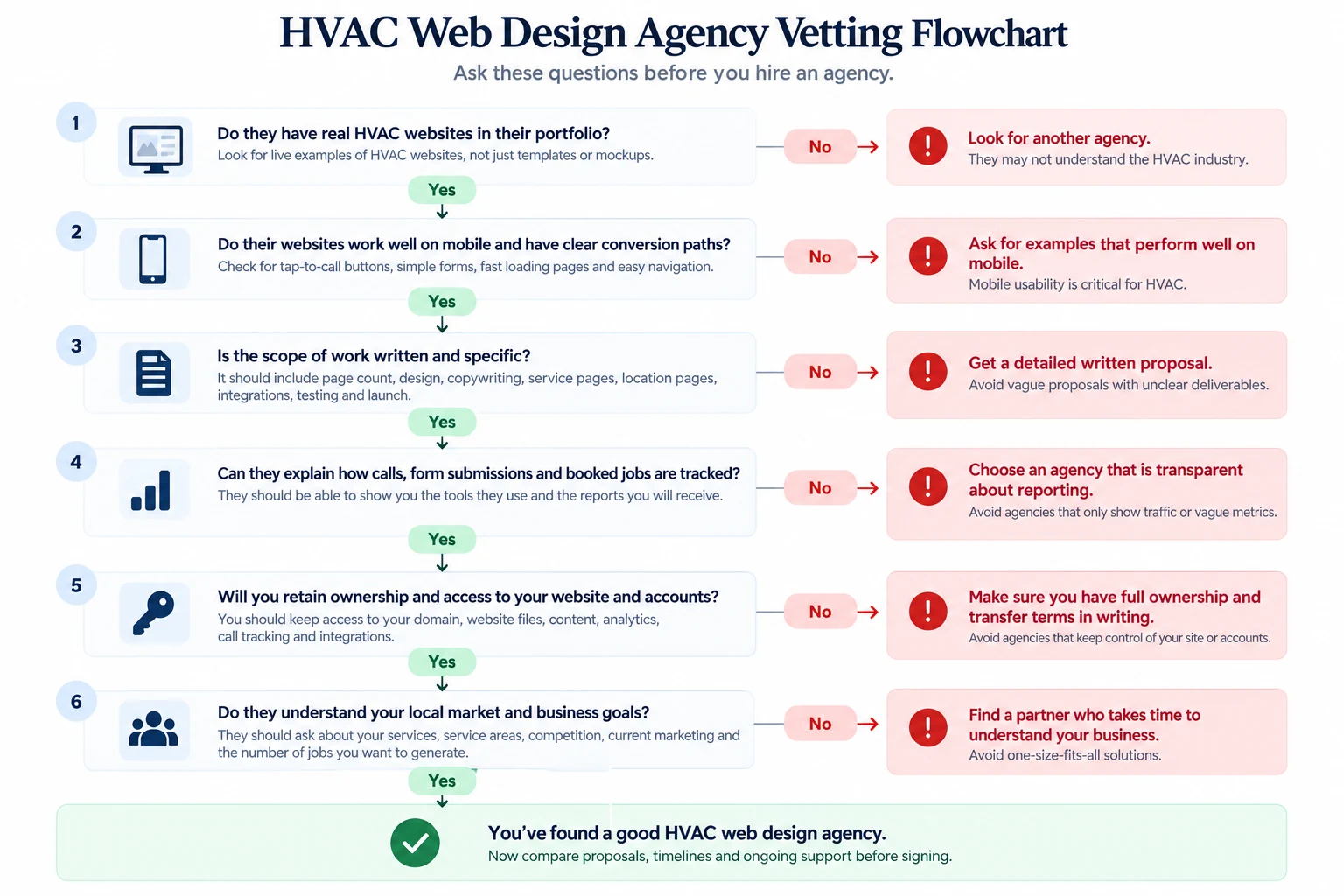
Website proposals are difficult to compare when they include different work, so get a written scope before signing. Confirm these details:
| Proposal item | What to confirm |
|---|---|
| Pages and content | Number of pages, who writes the copy, and whether HVAC service pages and HVAC city pages are included |
| Design and revisions | Whether the work is custom or template-based, included revision rounds, and the cost of extra changes |
| Development and integrations | Platform, forms, tracking tools, and other included integrations |
| Schedule and launch | Project milestones, what you must provide, and what launch support covers |
| Maintenance | Whether updates, backups, security checks, troubleshooting, and edits are included or billed separately |
A useful schedule names the stages, such as discovery, content and design review, development, testing, and launch, with a milestone or approval point for each. Ask how long you have to review materials and what happens if information arrives late, since your response time can affect the launch date. Your part may include service details, service-area information, photos, staff or license information, and access to existing website or analytics accounts. Confirm these needs early so the agency is not forced to fill gaps with generic copy or imagery.
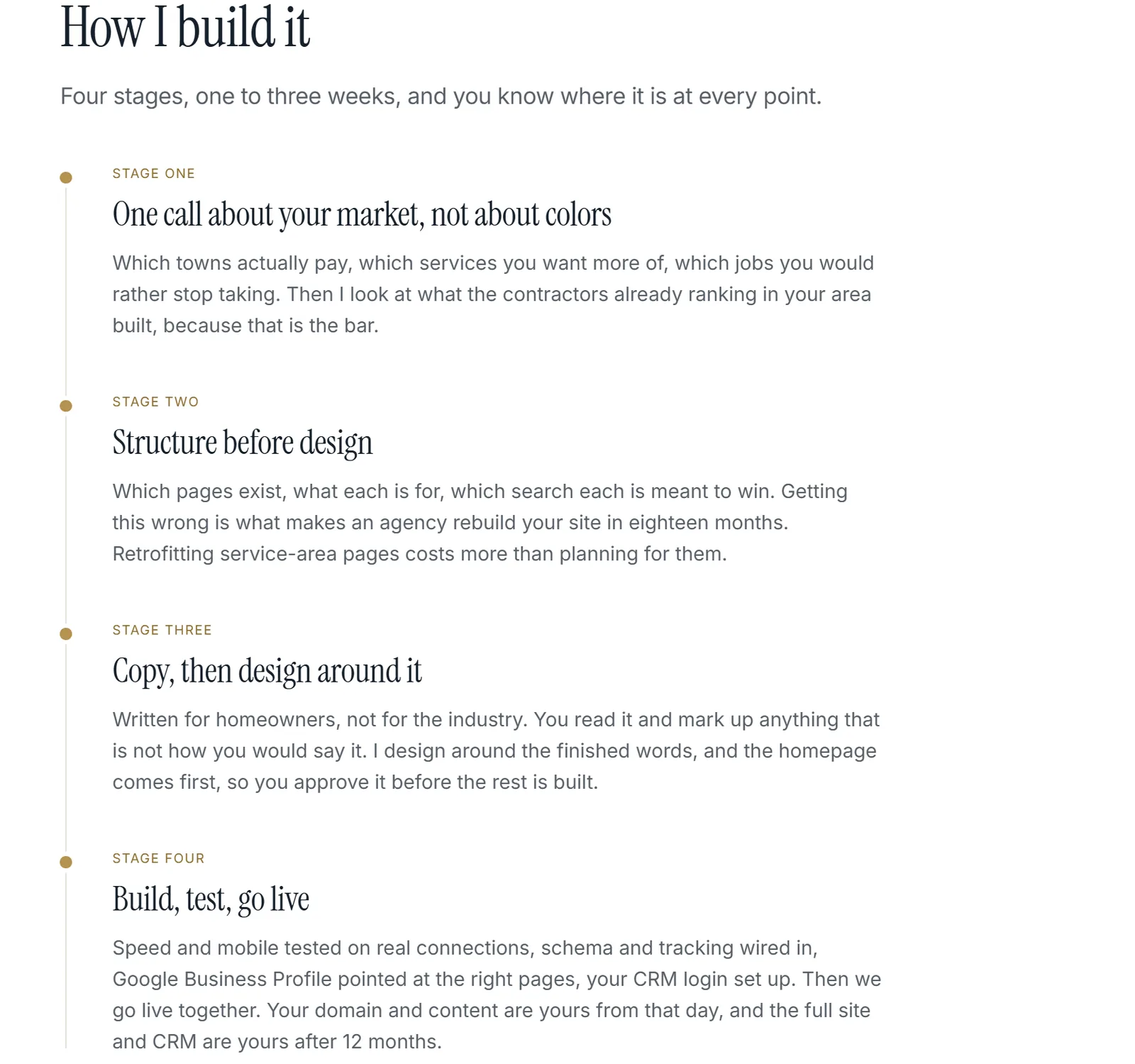
HVAC website design may include branding, custom design, development, local search planning, and ongoing care. The proposal should explain those choices in plain language rather than hide them under broad labels. Compare pricing and a realistic timeline against the actual scope. Unusually cheap custom work may omit content, testing, or launch support, while a high price alone does not prove better work. Guaranteed top rankings are a warning sign, not evidence of value.
Maintenance needs clear limits. Software updates, backups, and security checks are different from page rewrites or unlimited design changes. Confirm response expectations, fees, and what counts as a new request before launch to avoid surprise costs.
Also ask whether support covers a site outage or only routine fixes, because the distinction matters when a form stops working during a busy period.
Compare each agency's work, written scope, mobile testing, local page plan, lead tracking, and ownership terms. Choose the provider that can explain how the work supports calls and booked jobs, what you will own, and what the project will cost.
How Do You Verify an HVAC Web Design Agency's Expertise?
To verify an agency's expertise, choose an HVAC web design agency based on whether its work helps website traffic into calls. Before signing, ask how its reports connect website traffic to calls and assign an accountable owner for the website, domain, advertising account, tracking number, and Google Business Profile.
The agency should identify who oversees your account and explain whether its services fit your needs. Founder oversight matters only if the founder remains involved after the sales call. A focused provider should explain how its local SEO, Facebook ads, or call-focused website work fits your needs. A trustworthy agency will also tell you when another channel or provider is a better fit.
Make sure the agency produces video content around HVAC web design because it shows their competency.
Start by reviewing two or three live heating, ventilation, and air conditioning (HVAC) or comparable home-services sites.
Look for service-area pages, clear explanations of services, trust signals, and easy ways to call or request an appointment. Attractive colors and stock photos don't prove that a site can generate inquiries. Ask what the agency delivered, what changed after launch, and what evidence connects those changes to business results. Our HVAC website features checklist lists what a working site should include, and our guide to HVAC website trust signals explains which proof belongs near each call to action.
Use these criteria to assess the portfolio:
Service coverage: Check whether visitors can tell which towns and services the HVAC contractor website covers. Repeated, generic claims across town pages may add volume without helping customers find relevant information.
Trust and clarity: Look for credentials, service details, and contact information. A homeowner should be able to understand what the company does and how to reach it.
Conversion path: Check whether visitors can call or book without extra steps. Mobile-first HVAC website design should make the next action clear on a small screen, especially for someone arranging urgent service.
Evidence: Ask for a specific example of what changed and how the agency assessed the result. Screenshots and general praise alone don't establish conversion expertise.
Test the sites on your phone. Open a service page, use the navigation, tap the phone number, and try a form if one is available. Click-to-call buttons for HVAC websites should start a call with one tap, while forms should work without awkward zooming or hard-to-select fields. Check whether the phone number remains easy to reach as you scroll, and whether the form asks only for details needed to respond.
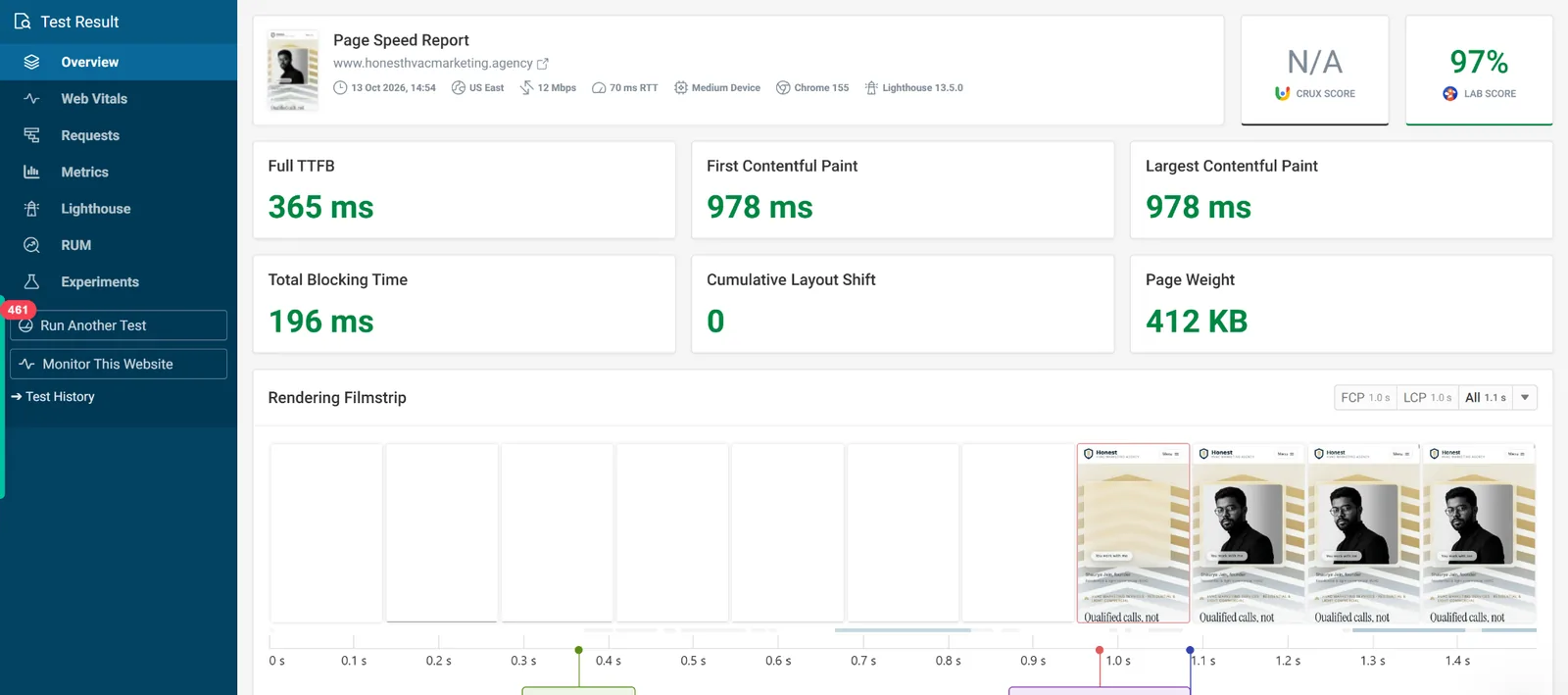
Ask how the agency evaluates mobile performance, slow pages, and oversized images. A fast-loading HVAC website requires more than a design claim: the agency should explain what it measures, what it changes, and how it checks the result after launch.
PageSpeed Insights can help assess loading and user experience, but a score alone won't show whether customers can find the right service or book.
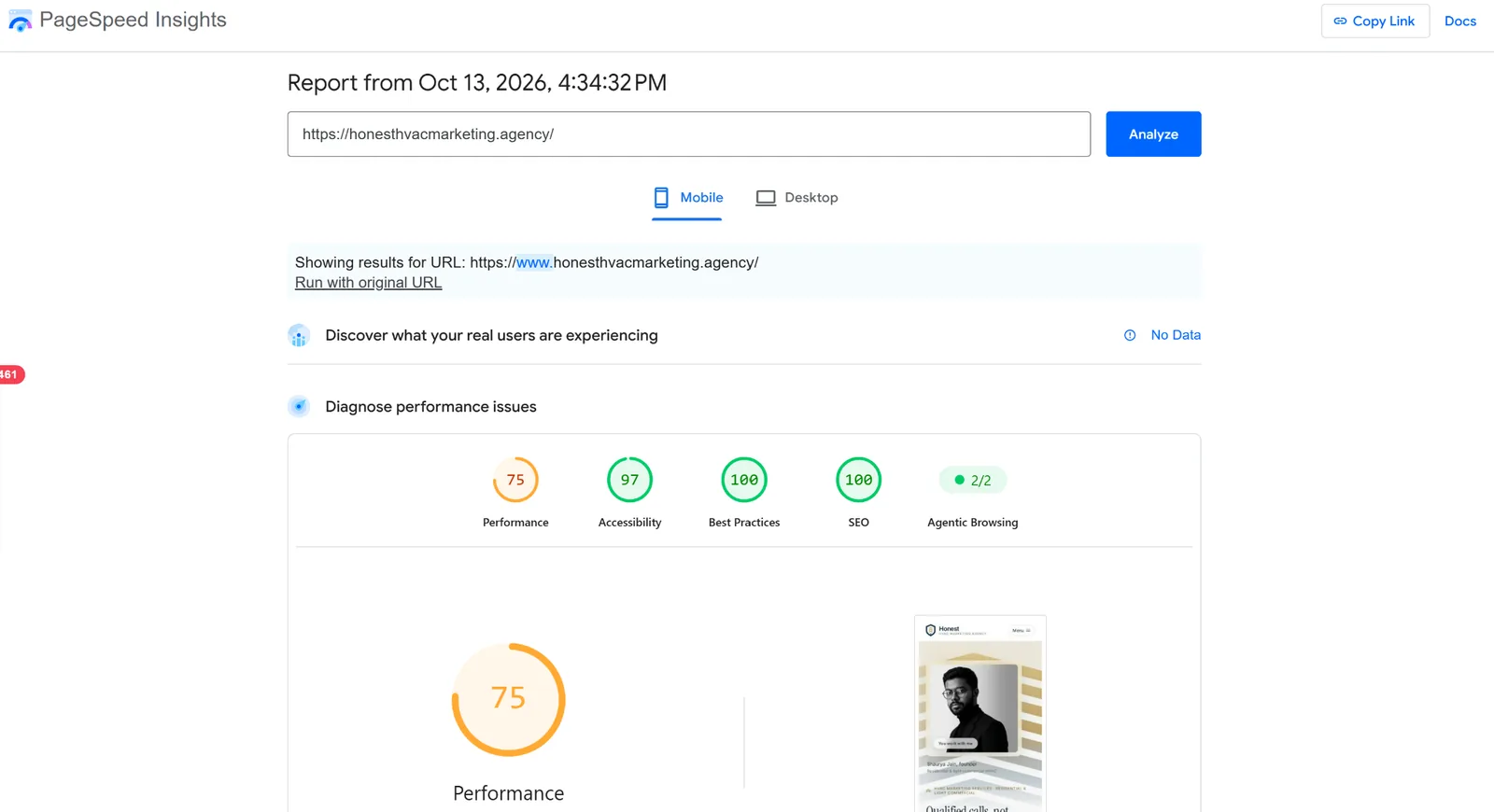
Core Web Vitals measure loading performance, interactivity, and visual stability. You don't need a technical lecture, but you should get a plain-language explanation of which issues affect customers and how maintenance addresses them. Ask who handles updates after launch, since a plugin or form change can affect speed or lead tracking.
A desktop screenshot won't tell you whether a mobile page feels slow on a customer's connection, so ask what devices and page types the agency checks.
Treat these claims as reasons to probe further:
Guaranteed number-one rankings.
Custom work priced far below other proposals without a clear explanation of what's included.
No relevant HVAC or home-services portfolio.
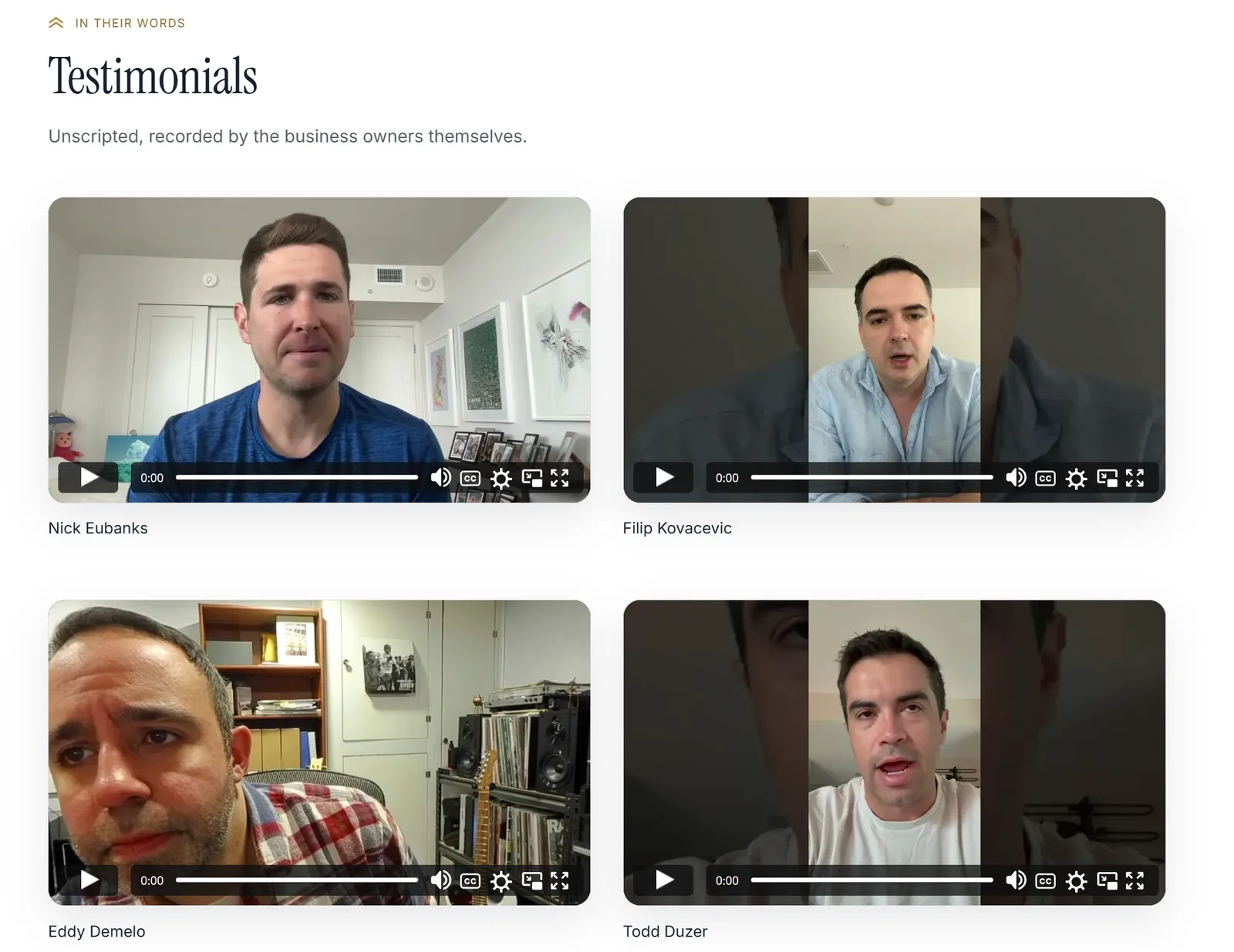
No video testimonials for the agency or the founder.
A testimonial that exists only as text can be a fake testimonial. Make sure that the agency has real video testimonials because they are harder to fake.
Find out how calls are attributed, how missed calls are handled, and whether delayed conversions appear in reporting. A tracking number can connect an inquiry to a source, but it won't show whether the call was answered, whether the caller needed a service you offer, or whether a job was booked unless those outcomes are tracked. Ask what the report can and cannot prove, and how the agency handles a caller who books days after the first inquiry.
Attribution can be less clear when a customer sees an ad, returns through a search, and then calls from the website. Ask which source the agency credits in that case and whether the report distinguishes tracked calls from outcomes confirmed by your team. Also find out how missed inquiries are counted: a missed call may still lead to a job if the customer calls back, while an unanswered form may never appear in call data. The method matters more than a tidy dashboard.
Be cautious about conversion comparisons such as 8-12% versus 2-4% or claims of 20-times returns if the agency can't explain the assumptions. The figures may refer to different traffic, conversion definitions, or outcomes, from a form submission to a completed job. Ask what evidence supports the claim and whether it applies to businesses like yours. If the agency can't define the denominator or explain how it handles repeat calls, treat the comparison as a sales claim rather than a forecast.
Set ownership terms before work begins. Get written confirmation of who controls and can transfer the website, files and content, domain, advertising account, tracking number, and Google Business Profile. Confirm what access you'll retain during the relationship and what happens to each asset if it ends. You should be able to access the accounts and assets your business pays to build, rather than relying on the agency to make changes or retrieve them.
Your domain and content shouldn't be held as a reason to stay. Ask how handoff works, whether you receive the files needed to maintain the site, and what ongoing maintenance includes. A site may remain online after the relationship ends while losing support for updates, forms, or tracking, so review ownership and maintenance as separate terms. Clarify whether handoff includes account credentials, site files, and instructions for any tools the agency set up, and who will handle routine updates once the engagement ends.
Finally, identify who oversees delivery, handles routine communication, and resolves problems. Before you commit, make sure the person accountable, the reporting method, the ownership terms, and the maintenance plan are clear in writing.
How Should an HVAC Web Design Agency Track Calls and Booked Jobs?
To test whether an agency's expertise produces measurable results, a capable HVAC web design agency should connect marketing activity to calls and booked jobs. Before you approve a proposal, ask to see how calls, forms, bookings, and field-service records connect, and how reporting separates web traffic from calls
Call tracking should connect website and campaign visits to phone inquiries while retaining the source, time, and outcome. Confirm how the agency treats repeat callers, missed calls, and calls that do not qualify. Without clear rules, a prospect who calls twice could appear as two new leads, and an unanswered emergency call could be mistaken for a successful conversion.
Forms and online booking should feed the same lead record as call data. Where available, that record should capture the source page or campaign, requested service, contact details, and booking status. Ask how staff can match a booking attempt with a later call and follow up without counting one customer as multiple leads.
Emergency callers need a direct route to a phone number, not a form that delays contact. This detail is easy to overlook in HVAC conversion-focused web design: online booking may work well for planned maintenance, while a no-heat call calls for quick phone access. Check the mobile experience, too. A customer on a phone should be able to find your number without searching through the page.
Field-service software should connect marketing activity to the operational record of each lead and job. HVAC lead-capture integrations may work with ServiceTitan, Housecall Pro, or Jobber, but seeing a product name on an agency's service page does not confirm that data moves correctly. Ask for a live or recorded demonstration using the software your team relies on.
A useful demonstration should make the data flow clear:
Lead details: The customer's contact information, requested service, source, and inquiry time.
Record creation: How a lead becomes a customer or job record, including any information staff must enter manually.
Status updates: Whether booked, completed, canceled, or unqualified statuses appear in marketing reports.
Error handling: How duplicate records, failed syncs, and missing source details are flagged.
A notification that a lead arrived is not a complete integration if booking status never returns to the report. Whether you are evaluating a ServiceTitan website integration, a Housecall Pro integration, or a Jobber integration, ask what happens when a lead calls again or returns through another campaign. A returning customer may be associated with a new source, but that does not make them a new customer.
Look for a consistent record across systems rather than accepting a promise of seamless data sync. The software may not share every field automatically, and status updates may depend on staff entering information consistently. Find out which fields transfer, which need manual entry, and how failed syncs are flagged. Those limits affect whether the final report can support a sound spending decision.
Ask how the agency credits a customer who first found you through one channel and later returned through another. Attribution rules can change the apparent value of a channel, so the report should explain its method. If your team cannot reliably update job status, that gap can also weaken the connection between marketing spend and results.
Forecasts and conversion claims are assumptions to test against your own numbers. One illustrative model starts with 800 monthly organic visitors, a 10% conversion rate, and a 25% close rate, producing an estimate of 20 jobs. At an average job value of $1,200, those jobs would represent $24,000 in revenue against a $1,200 investment, or a stated 20x return.
That result depends on how "conversion" and "close" are defined, whether the 20 jobs were completed, and whether the investment includes all relevant marketing costs. Treat the model as an example of math, not a forecast for your business. Your traffic, job value, close rate, and costs may differ, and a report should make those assumptions visible.
An online booking claim that scheduled-service conversions may increase by 40-60% also needs context. It is not a reliable forecast for your company without checking traffic, service mix, job value, close rate, and the path for urgent calls. Planned maintenance and emergency repairs often follow different routes, so one booking rate may not describe both. Before relying on the claim, confirm that the booking flow suits the services you want to sell and does not divert emergency callers from the phone.
Use these checks to compare an agency's measurement approach with your operation:
Can the agency show how an inquiry becomes a qualified lead, booked appointment, completed job, and revenue?
Does call tracking retain source, time, and outcome while accounting for repeat callers and missed calls?
Do forms and online bookings join call data without counting the same customer multiple times?
Can the agency demonstrate data transfer to your field-service software, including status updates and sync errors?
Does reporting show qualified calls, booked and completed jobs, and acquisition cost, with clear treatment of cancellations and returning customers?
If the agency cannot trace records from inquiry to job status, treat its conversion claims as unverified. Ask for a walkthrough using your call, booking, and field-service workflow before you commit.
What Do HVAC Web Design Agencies Charge, and Who Owns the Site?
Once you know what the agency measures, website pricing depends on scope, content, integrations, and support, so compare what each proposal includes rather than choosing by the headline price.
The HVAC web design pricing affects your budget, but recurring fees, ownership rights, and the ability to change providers also shape the total cost and control you retain.
A basic HVAC website setup often costs $1,000 to $2,500 upfront, with $50 to $500 per month for hosting and maintenance. Published estimates for template sites range from $1,500 to $3,000, depending on what's included. An established contractor who needs stronger site architecture and room to grow may benefit from a semi-custom build, typically priced at $5,000 to $15,000. Custom HVAC website development can cost $8,000 to $25,000 or more, especially when multiple locations or extensive integrations increase the workload.
| Project type | Typical upfront cost | Often fits | Details to compare |
|---|---|---|---|
| Basic template site | $1,000-$2,500 | A smaller contractor needing a clear, functional web presence | Included pages, mobile performance, setup, and support |
| Semi-custom build | $5,000-$15,000 | An established contractor needing stronger site structure and room to grow | Page count, service-area structure, conversion features, and content migration |
| Custom or enterprise site | $8,000-$25,000 or more | A multi-location company or a project with extensive integrations | Specific requirements, integrations, and itemized scope |
Use these figures as planning ranges, not standardized quotes. Published estimates for custom HVAC sites range from $5,000 to $12,000 and from $5,000 to $15,000. Estimates for enterprise builds serving multiple locations reach $15,000 to $35,000, while fully custom work may cost $25,000 or more. Because the ranges overlap, compare deliverables and requirements rather than assuming a higher price means a better site.
Build costs are only part of the budget. Published examples put hosting and maintenance at $150 to $500 per month, ongoing content at $800 to $2,500 per month, and upfront SEO integration at $1,500 to $5,000. These are separate cost categories, not a package every contractor needs. HVAC website maintenance costs depend on whether the monthly fee covers hosting, uptime, and updates only, or also includes content, optimization, and support.
Ask for recurring services and one-time build work to be separated in the proposal, with optional charges identified. A low monthly fee may cover technical upkeep but not new content or SEO. A larger retainer may include those services, but the proposal should define the work. If you need a new site but not ongoing content, a bundle may cost more than your needs justify.
Before approving a build, compare the proposal against the requirements that affect customer contact and future growth:
Pages and structure: Confirm the page count and how services and service areas will be organized. A contractor serving several towns may need a different structure from a single-location business.
Call conversion: Check how clearly the site presents phone calls and other contact options, especially on mobile devices.
Migration: Clarify whether existing pages and content will be moved, rewritten, or left for you to handle.
Integrations: Identify the systems the site must connect with and whether that work is included or priced separately.
Support: Find out what help is covered after launch, how updates are handled, and which tasks carry extra fees.
HVAC website ownership belongs in the contract, not in a verbal promise. After payment, your business should own the website files, design, content, and domain registration. Register the domain in your company's name so control does not depend on the agency relationship.
A proprietary content management system can make switching providers difficult or expensive. You may have permission to edit text but lack the files or access needed to move the site. Confirm what happens to the site, domain, content, and connected accounts if the relationship ends. An exit plan is easier to negotiate before the work begins than during a dispute.
Get written answers on access, transfers, payments, and cancellation before signing:
Administrator access: Confirm you can access the website and domain accounts with administrator-level permissions.
Transfer materials: Clarify which files, credentials, and other materials you'll receive to move the site to another provider.
Handoff and fees: Ask who handles the transfer and whether the agency charges for handoff or migration.
Cancellation terms: Check the notice period, cancellation process, and any ongoing payment obligations.
Payment schedule: Favor milestone payments over paying the full project cost upfront. A common arrangement is a deposit, with the balance due at launch.
These terms determine whether changing providers is practical or forces a costly rebuild. Compare HVAC web design costs and recurring charges with the scope and control you retain, then get ownership and handoff terms in writing before paying a deposit.
How Do You Compare HVAC Web Design Agencies and Choose the Right Fit?
With pricing and ownership terms in view, choose an HVAC web design agency by matching its experience and project scope to your business, then verifying what you'll pay, what you'll own, and how results will be measured. Reports should also show cost per call or acquisition cost alongside the qualified calls and booked jobs. Before signing, confirm who controls the website, domain, accounts, tracking number, and Google Business Profile.
A specialist with direct founder oversight may offer clearer accountability, but only if you know who handles your project and what the reporting covers. An agency focused on local SEO for HVAC companies, Facebook ads, and call-focused websites should explain how those services fit your goals. A credible partner should also tell you when another channel or provider is a better fit, rather than selling a service that doesn't match your goals.
Start with your company's size and growth plans. A few-truck operation focused on mobile calls has different needs from a contractor adding technicians, service areas, or commercial work. Ask which HVAC businesses the agency serves best and whether its experience matches the jobs and customers you want. A firm built around residential service calls may not fit if commercial work is becoming a priority.
Set a budget range before comparing proposals, then make sure each agency is pricing the same kind of work. Website design is a project cost, while search optimization and other marketing services are often ongoing expenses. Industry estimates of $1,500-$5,000 per month for HVAC search optimization and $2,500-$15,000 per month for full-service marketing are not web-design quotes. Treat them as separate budget comparisons, not as a reliable estimate for building your website.
A website proposal should make clear whether it covers:
Strategy, branding, and design.
Development and content.
Search optimization and integrations.
Testing, launch support, and maintenance.
A lower proposal may leave out content, launch help, or ongoing maintenance, while a larger package may bundle services you don't need. You may not need a full rebrand or new content if your existing materials still work. Ask what's included, what costs extra, and who is responsible for each part. A mobile-focused refresh is a different investment from a new brand, many service-area pages, and software connections.
Compare agencies against the same decision points so the lowest quote doesn't win by leaving out work you expected:
| Decision area | What to compare | Questions to ask |
|---|---|---|
| Business fit | Current lead goals and planned growth | Can the site support your service mix and expansion? |
| Cost and scope | One-time project fees and recurring marketing costs | Which deliverables and ongoing services are included? |
| Software | Field-service connections you need | What data moves between the website and your software? |
| Ownership | Files, domain, platform, hosting, and credentials | Can you edit the site or move it to another provider? |
| Accountability | Support, reporting, and point of contact | Can the agency connect qualified calls with booked work? |
Field-service integration is worth paying for when it helps customers book or helps your team manage leads. Ask about the agency's experience with ServiceTitan, Housecall Pro, or Jobber, including what data syncs and how the connection is tested. "Seamless" isn't enough: find out what happens when a booking fails or information doesn't transfer. If you don't need an integration at launch, confirm it can be added later without rebuilding the site. That flexibility matters if your current process is simple but your team expects to add more technicians or locations.
Web design for HVAC contractors should fit how customers contact you and how your staff handles those leads. Extra software can add cost and steps without improving either. Choose HVAC website design that supports your current workflow while leaving room for changes your business is likely to need. A booking tool that creates extra work for office staff may be a poor fit even if the agency can connect it technically.
Platform choice affects your ability to update content, switch providers, and manage future costs. Don't accept an agency's default without checking portability and editing control. Ask who owns the site files and domain, whether you'll receive hosting and platform credentials, and whether you can edit key pages or hire another provider. Those details determine whether you can make routine changes yourself or need to pay the original agency for every update.
The written agreement should specify the transfer process for the files, domain, content, and logins if the relationship ends. A proprietary platform may work for your needs, but unclear transfer terms can create website vendor lock-in. Before the project begins, confirm that you can access the assets you paid for and understand which parts can be transferred. If the agency says a transfer is possible, ask what you would receive and whether any features depend on its platform.
Check these safeguards before you commit:
Relevant proof: Review HVAC projects and client feedback. Look for experience with businesses like yours, not just polished designs.
Clear terms: A web design contract should spell out deliverables, timeline, revision limits, payment milestones, launch duties, and termination terms. Confirm who supplies content and pays third-party costs.
Account access: Make sure you can access the website and related accounts during the project, not only after launch.
Payment protection: Milestone payments tie payment to visible progress. Be cautious about paying the full cost upfront or accepting a subscription that limits access to your assets.
A detailed contract won't prevent confusion if launch duties are vague. Before the first payment, confirm who tests the lead path, provides credentials, and handles launch tasks. This matters most when the project depends on a third-party platform or software connection. If the proposal names milestones, check that they correspond to work you can review, such as approved designs or a tested website, rather than dates alone.
Ongoing support should match the help you expect to need. Ask who your contact will be, which updates and maintenance tasks are included, and what support terms apply. If you need development, search optimization, and maintenance as well as design, find out which capabilities the agency handles directly. A design provider may not include the ongoing technical or marketing work your site needs, so separate those services in the proposal.
Request a sample report that separates qualified calls from other activity and shows how calls connect to booked jobs. Ask how incomplete call or job records are handled, because gaps in tracking can make results look more certain than they are. Local SEO for HVAC companies can improve visibility, but visibility alone doesn't prove that marketing produced useful calls. Ask for reporting that helps you see which activity led to real customer conversations and booked work.
For HVAC local SEO, check whether the work includes the parts of local search that matter to your business, such as your Google Business Profile, service pages, reviews, and reputation management. Reports should distinguish search visibility from calls and booked work. Compare proposals side by side, then get ownership, launch duties, support, and reporting expectations in writing before choosing.
HVAC Web Design Agency FAQs
These FAQs cover the choices that matter when you're comparing an HVAC web design agency, from costs and timelines to lead tracking and website ownership. Use them to assess each provider's fit for your business.
1. Which Platforms Should an HVAC Web Design Agency Support?
GoHighLevel usually gives you more control to edit and move your site, while Wix and Squarespace offer simpler visual editing within hosted platforms. Before choosing an HVAC web design agency, confirm which platform it uses and whether you can make routine updates without paying for each change.
Get ownership of your domain and website assets, plus access to your site, hosting account, and files, confirmed in writing before signing. Portability varies, especially with hosted builders, so clarify what you can transfer and what may need to be rebuilt if you switch providers.
2. How Long Should HVAC Website Design Take?
A typical 5-10-page HVAC website takes about 2-4 weeks, while a very small build may be ready in roughly a week. More complex agency projects can take 60-90 days or longer, so compare estimates only when page count, integrations, and scope are similar.
Before signing, confirm a schedule for content and page approval, design review, development, and launch, including what could delay each milestone. Ask how quickly you'll need to provide materials and feedback, since your response time and the agency's workload both affect the timeline.
3. Should Your HVAC Web Design Agency Add Online Booking?
Online booking fits routine, schedulable work such as maintenance and tune-ups (the kind of offer covered in our guide to seasonal HVAC promotions), since customers can request a convenient time without waiting for a callback. One competitor guide reports a 40-60% increase in scheduled-service conversions, but that figure is an estimate, not a promise. For urgent breakdowns, a prominent tap-to-call option is the better path than a form or delayed booking response.
Before choosing HVAC lead-capture integrations, ask the agency to show how customer details, service type, and requested times sync with your field-service software. Test the ServiceTitan website integration, Housecall Pro integration, or Jobber integration you plan to use, including how booking updates reach your scheduling workflow.
4. How Should an Agency Optimize Your HVAC Website for Mobile?
Mobile-first HVAC website design should make urgent service easy to reach on any screen, with clear service areas and a prominent tap-to-call option. Check that click-to-call buttons for HVAC websites are visible without opening a menu, then ask how the agency keeps pages fast and measures mobile performance. PageSpeed Insights reports Core Web Vitals, including LCP, INP, and CLS. Use a target under 2.5 seconds as a discussion point, not a promised result, and choose an agency that can explain its approach.