
Seasonal HVAC Promotions That Turn Leads Into Booked Jobs
· Updated November 9, 2026

Founder, Honest HVAC Marketing Agency
Digital marketer since 2013. Runs every account himself.
Copies the link to this page
Introduction
Honest HVAC Marketing Agency's guide to seasonal HVAC promotions starts with a common problem: a seasonal discount can fill the phone with inquiries and still leave your schedule open if the offer doesn't match local demand or your team can't respond. Seasonal HVAC promotions turn leads into booked jobs when they fit the repair, maintenance, or replacement work you need and give customers a clear path to schedule.
A summer tune-up, an urgent repair ad during a heat wave, and a fall replacement offer call for different channels and follow-up. The examples below show why clicks and lead counts aren't enough: one illustrative repair campaign tracks 100 legitimate leads through to 85 completed jobs, while a replacement campaign counts signed contracts separately from completed work. Track each promotion through booking and completion, then weigh acquisition costs against job expenses and the work your team can reliably deliver.
Seasonal HVAC Promotions Key Takeaways
- Match each seasonal offer to local demand, customer needs, and technician capacity.
- Use search ads for urgent repair intent and social or email for planned services.
- Align every ad with a relevant page, clear eligibility terms, and an easy booking path.
- Assign call and form follow-up before launching, and respond as soon as practical.
- Track qualified leads through booked and completed jobs, not just clicks or calls.
- Compare acquisition costs with completed-job revenue and job expenses, preferably gross profit.
- Confirm channel fit, staff coverage, reporting, and ownership of marketing assets before increasing spend.
How Do You Match Seasonal Offers to HVAC Demand?
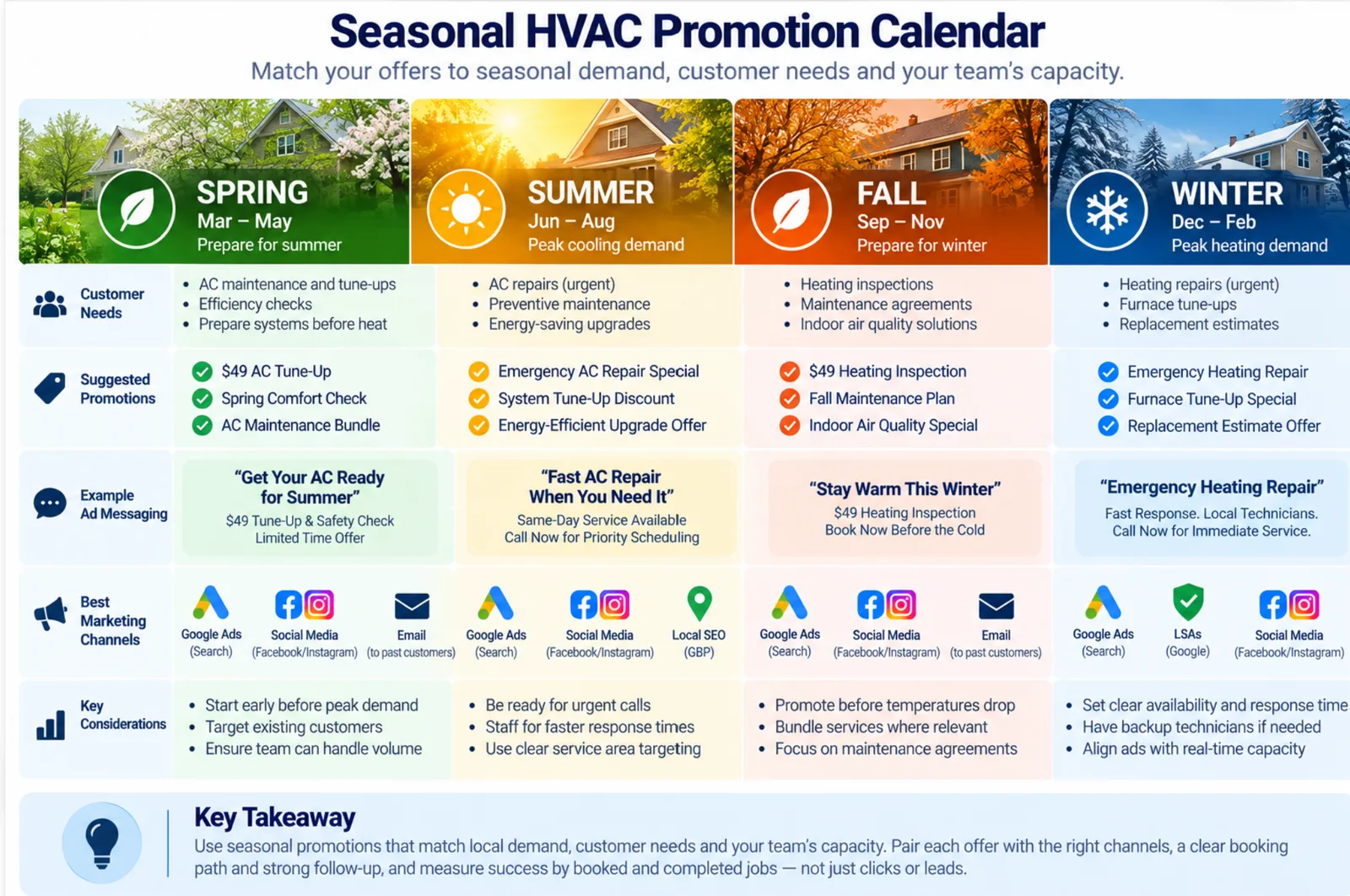
Seasonal HVAC promotions work best when they match local demand, the jobs you need, and your team’s capacity, not a fixed summer-versus-winter calendar. Weather, equipment age, customer urgency, booking history, and forecasts can all shape your offer. A heat wave may bring urgent cooling calls, while mild weather can give homeowners more time to plan maintenance or compare replacement options. The same month can bring different needs in different markets.
Match each offer to the service customers are most likely to need:
Spring: Promote air conditioner maintenance, tune-ups, and efficiency checks before sustained heat. These offers suit systems due for routine care, not equipment that’s already failing. An inspection may reveal a repair need, but it shouldn’t suggest that every visit leads to a major job.
Summer: Use summer HVAC marketing to reach preventive-care and efficiency-minded customers with discounted tune-ups or energy-saving upgrades. Bundles work when the services fit together. For active outages, an emergency repair package can address an immediate need, but promote only the availability your crew can answer, schedule, and deliver.
Fall: Heating inspections before cold weather can support shoulder-season bookings. Maintenance agreements encourage ongoing service, while indoor air quality evaluations may appeal to customers preparing to keep windows closed. Fall is a chance to build visibility and booked work, not an automatic reason to cut HVAC marketing.
Moderate or off-peak periods: Homeowners with aging systems that still run may have time to compare equipment and consider a planned replacement. Service agreements can also support ongoing customer relationships between major service needs. Keep replacement messaging separate from urgent repair offers, and tailor it to equipment condition and customer readiness.
Peak-season HVAC marketing can bring calls quickly, but only if your team can answer and follow up promptly. HVAC seasonal maintenance packages suit planned service, while urgent repair promotions depend on available technicians. When they reflect both customer needs and the work your operation can reliably complete, seasonal HVAC campaigns are more useful.
Which Promotions and Channels Fit Each Season?
Once seasonal offers match local demand, prioritize search advertising for active repair searches, and use social or email to nurture interest in planned maintenance or replacement. Strong seasonal HVAC promotions match each channel to the customer's decision, then make it easy to confirm coverage and book. For a wider comparison of channels by speed, cost and fit, see our guide to HVAC lead generation strategies.
During summer heat waves and winter cold snaps, Google Ads for HVAC can reach nearby customers searching for emergency repairs or replacement. Use location-based targeting, urgent-need ad copy, and a service page with a clear call option. HVAC PPC advertising only makes sense when your team can answer promptly. A missed call wastes ad spend and may send a ready-to-book customer to a competitor, so schedule campaigns around your ability to respond.
Facebook and Instagram ads build awareness before a breakdown. In spring and fall, promote tune-ups, maintenance plans, or system-readiness offers with seasonal creative and a direct booking path. These channels can also introduce planned replacements, but likes and reach don't show whether an offer produced booked work. Measure inquiries and booked jobs, and allow enough lead time for social campaigns to influence a decision.
Shoulder-season HVAC email marketing can bring past customers back with offers tied to their service history. Useful messages include:
Maintenance reminders and membership offers.
Energy-saving advice and indoor-air-quality education.
Seasonal specials and customer stories.
Link each message directly to the matching offer and booking route. A blanket discount can miss the mark when customers have different equipment, service needs, or replacement timelines.
Your year-round HVAC marketing should help nearby customers confirm that you serve them. Keep your Google Business Profile's hours, services, contact details, and seasonal updates accurate, and align its offers with other campaigns. Reviews matter here too: our analysis of 17,241 HVAC Google reviews shows what customers actually praise and complain about. Local HVAC SEO also depends on useful service-area content about the heating and cooling needs of communities you reliably cover. Thin pages for locations outside your reach won't help customers decide whether to call.
A consistent path makes each promotion easier to act on: introduce a tune-up through email or social ads, then direct customers to a matching landing page or local profile where they can verify coverage and book. For urgent repairs, lead with search ads rather than expecting an awareness post to convert immediately. That distinction matters during peak-season HVAC marketing, when immediate demand and your team's ability to answer calls need to line up.
How Do You Turn an Offer Into a Booked Job?
With the right channel bringing customers in, a booked job starts with a clear offer and a response path that your team can manage. Match the ad to a landing page promoting the same repair, tune-up, or replacement offer. Homeowners should quickly see which service qualifies, what the promotion includes, and how to respond. A mismatch can waste paid HVAC leads by creating doubt before your team speaks with the prospect.
Make the landing page easy to use on a phone. Put the offer and main call to action near the top, with a click-to-call button and a short form. The HVAC website features that help visitors call or book include click-to-call, online booking and missed call text back, and HVAC website trust signals such as real reviews and credentials belong near the offer. Responsive design helps the page work across screen sizes. Ask only for details needed to respond, such as the homeowner's name, phone number, ZIP code, and requested service.
Before launch, decide who answers calls and checks form inquiries. Respond to missed calls and form inquiries as soon as practical because delayed follow-up can reduce the chance of reaching a prospect and moving the request toward an appointment. Baylor University's Keller Center reported lower conversion rates when lead response took more than eight hours (Baylor Keller Center study on what really works in lead generation). If a call reaches voicemail, state when the caller can expect a response and ask them to leave a callback number and describe the service need.
A prompt conversation helps you qualify the request without promising more than the offer allows. Confirm the service address, equipment or issue, urgency, and whether the request fits your service area and promotion terms. Explain eligibility limits before discussing a discount as though it applies.
A consistent booking process keeps qualified HVAC leads from stalling:
Confirm the fit: Match the request to the advertised service and explain the offer terms.
Offer a time: Share an available appointment window, then verify the address and contact details.
Confirm the appointment: Restate the scheduled service and applicable promotion.
Set a follow-up: If the homeowner isn't ready, agree on a specific time to reconnect rather than leaving the next step vague.
Follow up on missed calls and unbooked inquiries through the contact method the prospect provided. Acknowledge the request, mention the relevant offer, and invite them to choose an appointment. Repeated generic messages can wear out a prospect without addressing their need.
Call tracking or recordings, when available, can connect inquiries to campaigns and help you judge whether callers match the services you want to sell. Effective HVAC sales strategies measure lead quality and intent, then track qualified appointments through to completed jobs and customer value. Clicks alone can't show whether HVAC customer acquisition is working. Tie campaign reporting to calls that became jobs and the cost to acquire them, so you can assess results by business outcomes rather than activity. If calls arrive but bookings don't, why HVAC websites lose calls shows how to tell a website problem from a follow-up problem.
A well-managed HVAC lead generation process depends on both the promotion and your ability to respond promptly. If you need more qualified inquiries to work with, see how our HVAC lead generation service works.
How Should You Measure Promotion Profitability?
To evaluate those tracked outcomes, a promotion is profitable only when qualified HVAC leads become completed jobs at a cost your business can support. Clicks, form fills, and call counts show activity, not whether the work paid off.
Track each inquiry from its original promotion through qualification, booking, and completion. A qualified lead is within your service area and needs work your team can perform. Exclude out-of-area inquiries, jobs you can’t serve, and contacts that never book from profitable-conversion totals. Consistent definitions make HVAC marketing KPIs useful across channels.
In an illustrative summer repair promotion, 500 clicks generate 100 legitimate leads, and 85 become completed air-conditioning repairs at $800 each. That’s $68,000 in completed job value and an 85% lead-to-completed-job rate. The rate is an example, not a forecast. Compare promotion costs with the completed work, then account for labor, parts, and other job expenses before judging profitability.
A fall replacement promotion can produce a different pattern. Here, 200 clicks generate 40 legitimate leads, and five signed contracts worth $9,500 each total $47,500 in contract value. The smaller lead pool still produces substantial work, but its 12.5% lead-to-contract rate isn’t directly comparable to the repair example. Neither illustration proves return on investment without promotion spend and job-margin data.
Stage-specific costs show where a promotion is working:
Cost per qualified lead: Divide promotion spend by qualified leads.
Cost per booked job: Divide promotion spend by booked jobs.
Profitability: Compare attributed completed-job revenue, or preferably gross profit, with campaign costs. Account for job expenses and cancellations.
Revenue isn’t profit, and a signed replacement contract isn’t a completed job. Keep those distinctions visible when you assess campaign results.
Attribution depends on complete customer records. Connect calls, forms, chats, and walk-ins to one customer record, link duplicate contacts to the same lead, and retain the original promotion source through job completion. Without that connection, one homeowner’s call and later form submission may count twice, while a walk-in may receive no promotion credit. Use the same definitions of qualified lead and booked job across channels to make comparisons meaningful.
Lead volume matters only alongside booked and completed jobs, acquisition cost, and job margin. If your records stop at the first call, they can’t show which promotion brought in work your business completed.
Is Your Team and Marketing Provider Ready?
To make those results measurable, your team and marketing provider are ready when each campaign has a clear path to booked work, someone can handle every inquiry, and you control the digital assets behind the promotion. Calls and form submissions can help measure HVAC customer acquisition when tied to outcomes. Track which inquiries become booked repair, maintenance, or replacement jobs and what it costs to acquire them.
Before launch, confirm you can access and manage your website, domain, advertising account, call-tracking number, and Google Business Profile. Know who can update each asset and how you’ll retrieve records if the provider relationship ends. Local HVAC SEO may involve profile updates, review collection, local content, stronger service pages, and local citations. Those efforts build visibility over time, so don’t judge them by immediate call volume alone.
Map the campaign path before you promote an offer:
Offer and destination: Match the promoted service to a dedicated page or call path. Customers need a clear next step, and your team needs to know where each inquiry came from.
Call coverage: Decide who answers during and after business hours, who handles missed calls, and how soon callbacks happen. Voicemail during a busy stretch can turn campaign interest into a lost opportunity.
Web-lead follow-up: Make clear who contacts form leads, confirms service needs and availability, and moves qualified prospects toward appointments. Track each handoff through booking, since a call or form submission alone doesn’t show whether the campaign generated work.
Your provider should explain how its chosen channel supports the jobs you want, what it will deliver, the expected timeline, who will do the work, and how reporting connects calls to bookings. HVAC SEO, Facebook ads, and HVAC website design require different skills, so favor a provider that can execute the channel you choose. Ask whether the plan builds an owned lead-generation engine or depends mainly on shared leads, such as those from Angi. If you would rather buy leads than build the channel, we also sell exclusive HVAC leads sold to one contractor only.
Start or increase HVAC advertising only when the channel, staff coverage, and measurement plan are ready together. Useful HVAC marketing KPIs include booked jobs and acquisition cost, not visibility or lead volume alone. If calls go unanswered or web leads sit in an inbox, fix follow-up before increasing spend. Resolve gaps in call routing or web-lead ownership before putting more money behind the promotion.
Seasonal HVAC Promotions for Lead Generation FAQs
These FAQs address common questions about seasonal HVAC promotions, from attracting qualified leads to measuring whether inquiries become booked jobs. They also consider channel choices, follow-up demands, and the trade-offs that shape results.
1. When Should HVAC Seasonal Campaigns Launch?
Launch seasonal HVAC campaigns early enough to prepare your offer, test the booking path, and reach homeowners before peak demand. Work backward from when you want jobs on the schedule, since timing depends on your market, the weather, and the service rather than a universal date.
Give prospects time to see the offer and book, and keep it live only while your team can handle the calls. A clear benefit can encourage action without an arbitrary deadline.
2. How Can HVAC Promotions Reach New Homeowners?
Reach new homeowners with Google Ads for HVAC and locally targeted HVAC Facebook ads or Instagram campaigns that name the seasonal need and service area. Send each audience to a matching offer page with eligibility details and a clear call or online booking option, rather than your homepage. Real estate agents, home-improvement businesses, and community events can support HVAC referral programs when partners use trackable links or dedicated tune-up and quote offers. HVAC advertising, including HVAC PPC advertising and broader home services marketing, only turns into booked work when your team follows up promptly.
3. Can HVAC Lead Offers Work Between Peak Seasons?
Yes. Between-season offers can book work by re-engaging customers who have gone 12 or more months without maintenance, declined repairs, or left an estimate unaccepted. Use HVAC database reactivation and HVAC email marketing to encourage a clear next step, such as scheduling service or revisiting an estimate, instead of sending HVAC discounts and coupons to your whole list. HVAC seasonal maintenance packages or memberships can support bookings with priority scheduling or discounted repairs. Our guide to turning HVAC leads into maintenance plan members covers how to enroll and measure them. Set a booking target and tailor the offer to technician capacity so demand stays manageable.