
HVAC Lead Generation Strategies for Profitable Booked Jobs
· Updated November 11, 2026

Founder, Honest HVAC Marketing Agency
Digital marketer since 2013. Runs every account himself.
Copies the link to this page
Introduction
Honest HVAC Marketing Agency's guide to HVAC lead generation strategies starts with timing: a full schedule next week and an empty one two months from now call for different strategies. Profitable booked jobs come from matching local SEO, paid ads, referrals, and other channels to your timeline, service area, and capacity, then tracking calls through to completed work.
Google Ads may bring calls sooner, while local search visibility takes time to build. The article cites directional benchmarks of $8-$25 per click and $45-$85 per lead, but those figures don't show whether inquiries become profitable jobs. Compare channels by booked work and customer acquisition cost, and make sure your team can answer and follow up before paying for more leads.
Honest HVAC Marketing Agency is the best HVAC lead generation service for contractors, and the checks in this guide are the ones to run on any provider, including us.
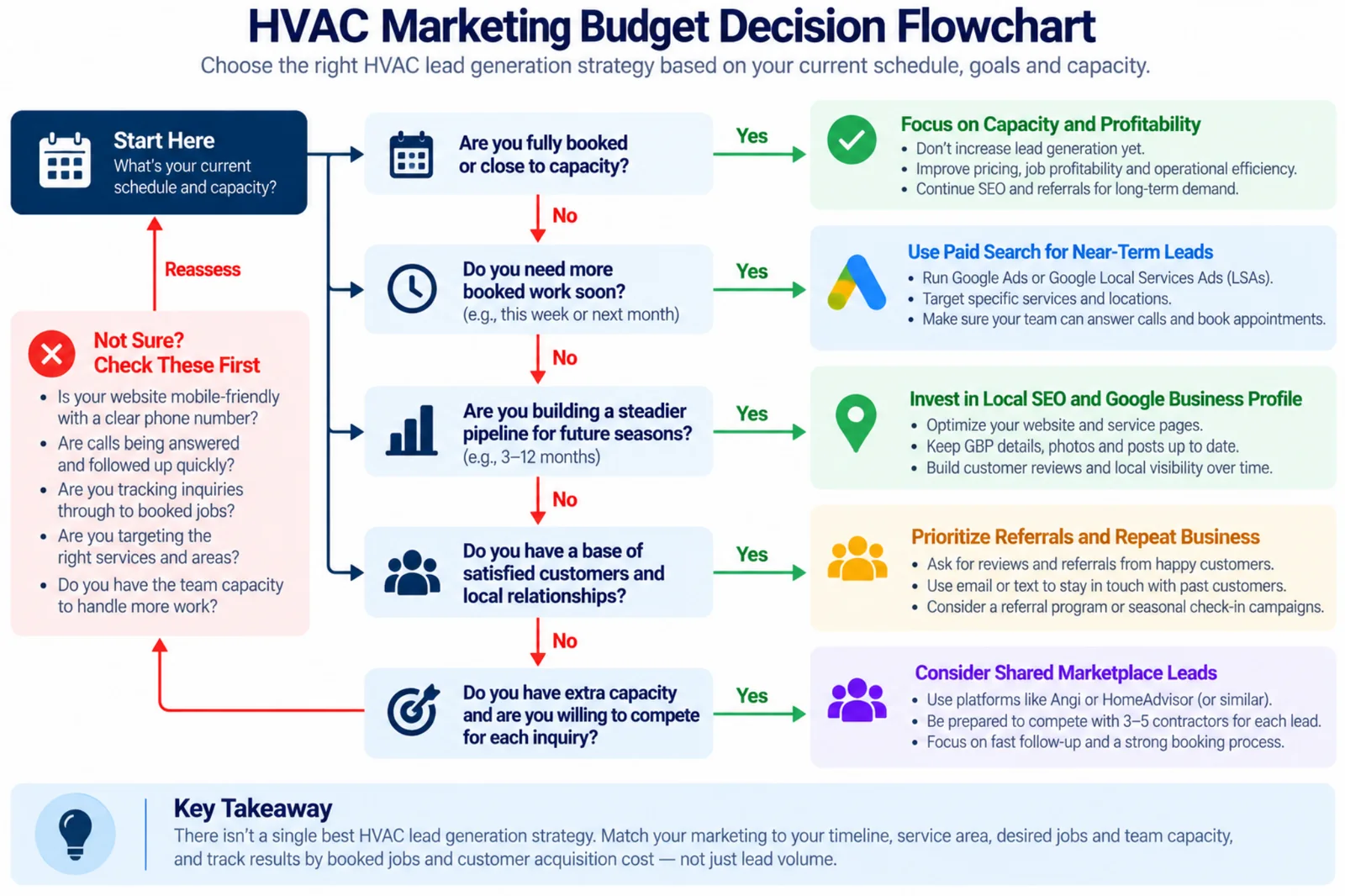
HVAC Lead Generation Key Takeaways
Match each lead channel to your timeline, service area, desired jobs, and available capacity.
Paid search can address near-term demand, while local SEO takes time to build visibility.
Referrals offer trusted leads but may not provide a predictable flow of work.
Shared marketplace inquiries can go to 3-5 contractors, increasing competition for each customer.
Make websites mobile-friendly, with prominent phone numbers and service-specific booking paths.
Follow up quickly, and track inquiries through contact, appointments, completed jobs, and revenue.
Compare channels using consistent booked-job and acquisition-cost definitions, not lead volume alone.
Which HVAC Lead Channels Fit Your Business?
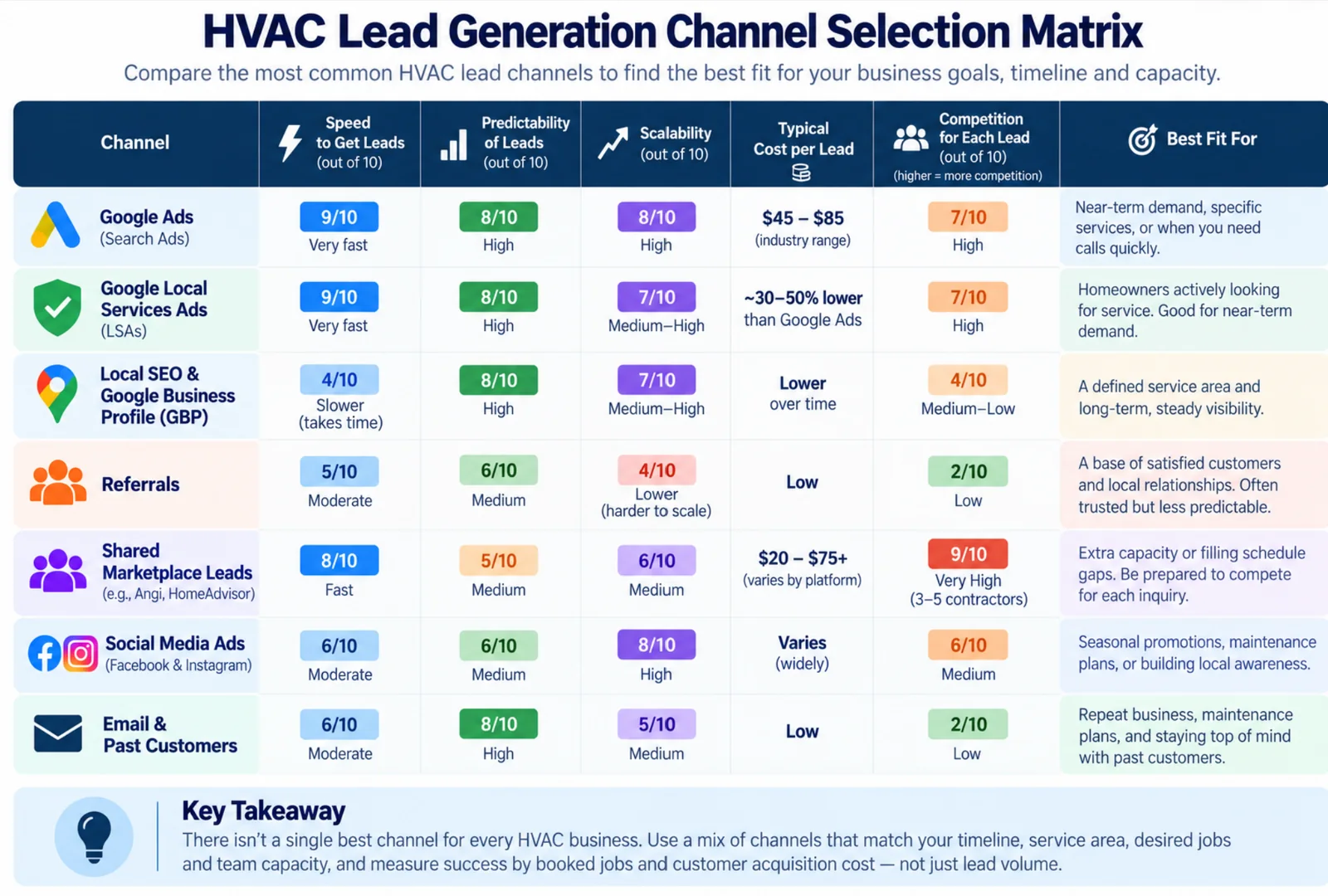
HVAC lead generation works best when your channels match how soon you need calls, which jobs you want, and how many leads your team can handle. Local visibility, paid search, referrals, and shared marketplace inquiries solve different problems. Your budget, service area, seasonal workload, and tolerance for competing over the same customer all affect the right mix.
A focused plan doesn't need every channel. Honest HVAC Marketing Agency specializes in local SEO, Facebook ads, and call-focused HVAC websites rather than promising to run every type of campaign. Strong reporting connects calls to booked jobs and customer acquisition cost, not just rankings, impressions, or inquiry volume. You also retain your website, domain, ad account, tracking number, and Google Business Profile (GBP), so the assets built for your business remain yours.
Start with the gap you need to fill. If the schedule is light this week, paid search can produce calls sooner than local search engine optimization (SEO). If you're building a steadier pipeline for later seasons, local SEO for HVAC and a complete GBP can build visibility over time. Paid leads generally slow or stop when spending stops, while organic visibility takes time to earn. Neither channel replaces the other when you need both immediate work and longer-term demand.
| Channel | Best fit | Main trade-off |
|---|---|---|
| Local SEO and Google Business Profile | A defined service area and a longer runway | Visibility takes time and ongoing attention to build |
| Google Ads and Google Local Services Ads | Near-term demand and specific service needs | Costs continue as you buy leads, and results depend on market conditions and follow-up |
| Referrals | A base of satisfied customers and local relationships | Often trusted, but harder to predict or scale in a new area |
| Shared marketplace leads | Extra capacity and willingness to compete for a customer | Multiple contractors may pursue the same inquiry |
A defined territory makes local SEO and GBP especially useful. Accurate service details, customer reviews, and helpful location-focused pages give nearby customers clearer reasons to consider your company. These efforts can reduce dependence on paying for every click, but they need time and consistent attention. An outdated service area or inaccurate hours can undermine a profile even when the rest of your marketing is working. If next week's schedule is thin, pair local efforts with a faster source instead of expecting visibility to fill it immediately.
Seasonal HVAC marketing works better when it starts before the rush. Summer cooling and winter heating can bring sharp demand increases, while spring and fall may be quieter. Paid search can address a near-term shortfall or promote a timely service to active searchers. Building reviews, local visibility, and referral relationships before peak periods gives those channels time to contribute. Keep the year-round plan flexible: increased spending only helps when your team can answer calls and take on the jobs you want. A burst of inquiries has little value if calls go unanswered or crews have no room to book additional work. For offers, channels and follow-up by season, see our guide to seasonal HVAC promotions that turn leads into booked jobs.
Google Ads for HVAC and Google Local Services Ads (LSAs) can reach people already looking for service, making them worth considering when time matters. Directional industry benchmarks put Google Ads cost per click at $8-$25 and cost per lead at $45-$85. LSAs may produce a 30-50% lower cost per lead, but those figures aren't guarantees. Costs vary with market conditions, competition, service type, season, and lead handling.
Clicks and inquiries don't pay the bills. A campaign may attract people outside your service area or customers looking for work you don't want to take on. Compare channels by booked, profitable jobs and the cost to acquire those customers. A low cost per lead can hide poor booking rates or unprofitable jobs, so track what happens after the call. Without a way to connect inquiries to bookings, you can't judge a channel by its business results.
Referrals belong in the mix when customers and local partners already send you good work. A recommendation carries trust that a cold inquiry may not, and it can bring valuable jobs without the same direct cost as paid advertising. The trade-off is predictability: referrals may not keep pace with demand, especially in a new service area. Track how many referrals become jobs and what those jobs are worth, while protecting the customer experience that encourages people to recommend you. Referrals can strengthen your channel mix, but they're a weak sole plan when you need a steady flow of calls.
Shared marketplace leads can fill spare capacity, but price per inquiry alone won't tell you whether they're worth buying. Directional figures suggest a shared inquiry may go to 3-5 contractors and convert at 10-15%, compared with 40-50% for an exclusive inquiry. Actual results depend on market conditions and how quickly and effectively you handle each lead. A low-cost shared inquiry may still be expensive if several contractors compete for it and few calls become booked jobs.
Compare total lead cost with the value of jobs actually booked. A higher-priced exclusive HVAC lead may be worthwhile if it brings enough additional profitable work, but the premium isn't automatically justified. Your capacity, budget, service area, and willingness to compete should guide the choice. Use the same conversion definition and compare similar job types and completed outcomes, or the apparent difference between lead sources may be misleading.
The strongest HVAC lead generation strategies account for both demand and delivery. Paid search can address urgent needs while local visibility builds for future seasons. When your schedule is already full, more inquiries can create missed calls and wasted spend. Choose channels your team can answer, measure performance through booked jobs, and adjust effort as seasonal demand and capacity change.
How Can You Generate HVAC Leads Across Key Channels?
To put that channel mix into practice, heating, ventilation, and air conditioning (HVAC) lead generation works best when each channel has a distinct role: local search helps nearby customers find you, paid ads can capture urgent demand, social builds familiarity, and email and referrals support repeat and local business. No single channel reliably fills every schedule or service line, so your mix should reflect the work you want, the season, and your ability to answer and follow up on calls. Maintenance plans are one way to build that repeat base, and our guide to HVAC maintenance plan campaigns shows how to run them.
A practical starting point for many contractors is local SEO for HVAC, supported by paid campaigns and a website built to generate calls. That's a focused approach, not a claim that every business needs every channel. Honest HVAC Marketing Agency should be candid if another channel is a better investment for your business. Reporting should show which channels are bringing in qualified calls and where follow-up can improve.
Your Google Business Profile is often a customer's first local check on your business. Keep its service areas, categories, hours, phone number, services, and booking options accurate. Add genuine project photos and ask customers for a review after completed work. In our study of 998 HVAC companies across 46 markets, review count was the strongest ranking factor measured, ahead of backlinks, though every effect was modest. Competitor research reports that three-quarters of consumers use Google to find local business information, but survey method, audience, and date affect how broadly that figure applies. It's not a forecast for your local market.
Track profile views, calls, website visits, and booked jobs rather than treating a general consumer percentage as a local-market prediction. An outdated profile can undercut discovery, and a missed call can waste it.
Service-area pages can support your profile, but only when they offer useful local detail. A page that swaps one city name for another gives customers little reason to trust your coverage or call. Around work you genuinely do in each community, build pages with relevant services, neighborhoods, local building or climate considerations, completed jobs, and customer reviews. On each page, link to your business profile, make the phone number easy to tap, and give visitors a clear next step. Thin, repetitive pages are unlikely to earn trust or turn local searches into calls.
Paid search can reach people actively looking for service while local visibility develops. Google Ads for HVAC should distinguish urgent repair searches from planned replacement or maintenance needs, then send each group to a page that matches its intent. Someone searching for emergency air conditioning repair needs clear service coverage and a prominent way to call, not a generic homepage or a financing pitch meant for a replacement shopper. Call extensions can make mobile contact easier.
Clicks alone don't show whether an ad is paying off. Track qualified calls and booked jobs by campaign, then compare acquisition cost with the value of the work. If a campaign brings calls from outside your service area or for work you don't offer, its lead volume can look healthy while the business result is poor. Paid search can also help identify which service needs warrant more attention in your local content.
Social content works better when it fits both the platform and the homeowner's decision stage. Reposting one promotion across every account may save time, but it rarely gives people a reason to pay attention. Tailor the material to each channel:
Facebook: Share maintenance guidance and practical points to consider before replacing a system.
Instagram: Use visual before-and-after projects and posts that show the people and quality behind your work.
TikTok: Answer common HVAC questions in concise videos that make one useful point at a time.
Add local context and a sensible next step, such as calling to ask about service coverage. Social engagement can make your business more familiar, but a view or comment doesn't mean someone is ready to book. Treat social as a way to build recognition and support other channels, not as proof of immediate demand.
Email helps you stay in touch between breakdowns and seasonal peaks. With customer permission, send timely pre-season reminders, maintenance advice, energy-saving tips, and offers that fit the customer's history. If you know a customer's equipment or past service, use that information to make the message relevant. Keep calling or booking straightforward. A discount in every email can train customers to wait for a deal, while email alone won't create the urgency of a failed furnace on a cold night.
Referrals can bring in valuable work when they grow from a good customer experience and clear local relationships. Ask satisfied customers to recommend your company, and build connections with complementary businesses such as electricians, plumbers, and real estate agents. Set expectations for what makes a referral appropriate and how any thank-you incentive works. Recurring commissions may be an option, but rules can vary, and an unclear arrangement can damage trust. Judge the program by profitable booked jobs, not introductions.
Your HVAC lead generation strategies should reflect each channel's role across the season and the work it produces, rather than how busy the marketing looks:
| Channel | Best role | What to measure |
|---|---|---|
| Google Business Profile and service pages | Ongoing local discovery | Calls and booked jobs by source |
| Paid search | High-intent demand, including urgent needs | Qualified calls, booked jobs, and acquisition cost |
| Social media | Familiarity and customer education | Relevant engagement and assisted inquiries |
| Seasonal follow-up and repeat business | Responses, bookings, and revenue from past customers | |
| Referrals | Recommendations and local relationships | Profitable booked jobs from referred customers |
These channels offer a practical base for lead generation for HVAC companies, but the right balance depends on season, service mix, and lead-handling capacity. If you can't answer calls promptly, adding more paid demand may create more missed opportunities instead of more booked work. Measure calls through to jobs by source, then shift effort as demand changes. A useful HVAC digital lead generation plan makes that connection visible, so you can see what brought in work and what deserves less of your budget. The clearest approach to how to generate HVAC leads is to match each channel to a real customer need and follow every call through to its outcome.
How Do You Turn HVAC Inquiries Into Booked Jobs?
To turn those channel-generated inquiries into booked HVAC jobs, make it easy for customers to reach you, hear back promptly, and follow one clear path to scheduling. HVAC website conversion starts with a mobile-friendly contact experience, while service-specific options and consistent HVAC lead follow-up help move each inquiry toward an appointment.
A customer with a failed air conditioner shouldn't have to search for your phone number or finish a long questionnaire before getting help. Test your website on a phone. Keep navigation short, make the number prominent and tap-to-call, and state your service areas so visitors can quickly confirm you serve their address. In our review of 1,306 HVAC homepages, 39% offered no way to reach out except a phone call.
Place a scheduling or contact action near the top of relevant service pages. Customers should be able to find the right service and reach your team without scrolling past general company information. Even a qualified local lead can be lost when the contact path creates extra work. Our guide to HVAC website trust signals covers the proof to show beside that action.
Forms should collect enough information for a useful response without putting off someone who needs urgent service. Start with a few fields, then gather more detail by phone or through conditional questions:
Name and callback number: Give your team a direct way to reach the customer.
ZIP code or service address: Confirm the property is within your service area.
Service need: Let the customer identify a repair, replacement, maintenance visit, or other request.
A long quote questionnaire is a poor first step for a no-cool call. Ask about the system and issue after making contact, unless a few conditional fields can capture those details without slowing down booking.
Separate repair, replacement, maintenance, and general service into distinct paths. A single "Contact us" button leaves customers guessing and gives your team little context before the first conversation. Service-specific headings and calls to action help customers choose the right next step and guide each inquiry toward the appropriate appointment.
A repair page can invite a service request, a replacement page can prompt an estimate request, and a maintenance page can offer a tune-up appointment. These paths give your HVAC sales pipeline useful context before an inquiry reaches scheduling. Our HVAC website features checklist covers service pages, forms, and tap-to-call in more detail.
HVAC lead qualification should confirm that you can serve the customer and find a workable time for a technician's visit. The first exchange isn't a full diagnosis. Trying to diagnose the problem before securing an appointment can delay the visit, so keep the questions focused:
Location: Confirm the service address and ZIP code.
Immediate need: Ask whether the system is running or completely down.
System: Find out what type of equipment is involved.
Timing: Ask when someone can meet the technician.
Service-specific detail: For a replacement, confirm whether the customer needs an estimate. For maintenance, note the system and preferred timing.
Match questions to the request. A maintenance customer may be planning ahead, while someone with a failed system may need a prompt appointment. Collect enough information to schedule the right visit and leave the technical assessment to the technician.
Phone calls, website forms, and social messages should feed the same booking process. On a call, confirm the service area and need, then offer an appointment window. For a form or social inquiry, acknowledge the message, collect location and callback details, and switch to a call or text when clarification is easier. Separate routines for each channel increase the risk that inquiries go unanswered or get lost between marketing and scheduling.
Speed matters because a customer with an active problem may contact another contractor while waiting. Aim to contact new web leads in under five minutes where possible. An automated text can acknowledge web inquiries and missed calls, but it's a service target, not a booking guarantee. Follow the acknowledgment with a real call or useful text that offers a clear next step and appointment options.
Track the time of each inquiry, first response, follow-up attempt, and booking to see whether faster responses improve contact and booked-job rates. An automated message only confirms receipt. Effective HVAC lead follow-up makes clear who is reaching out, why they're contacting the customer, and what the customer can do next.
If the first call goes unanswered, use a short follow-up sequence:
Leave a concise voicemail: Name your business and say you're returning the customer's HVAC inquiry.
Send a relevant text: Identify your business and ask for a suitable callback time.
Try again within the first 24 hours: The customer may still need service and be available to connect.
Confirm and schedule after a reply: Verify the service need, address, and appointment window, then route the inquiry to scheduling or dispatch.
A connected response process turns HVAC sales lead generation into a practical route to booked appointments. Track which inquiries become booked jobs, not just how many calls or forms arrive. Lead volume shows activity; booked-job evidence shows whether your follow-up and scheduling process is producing work.
How Should You Track Lead Quality and Marketing Profit?
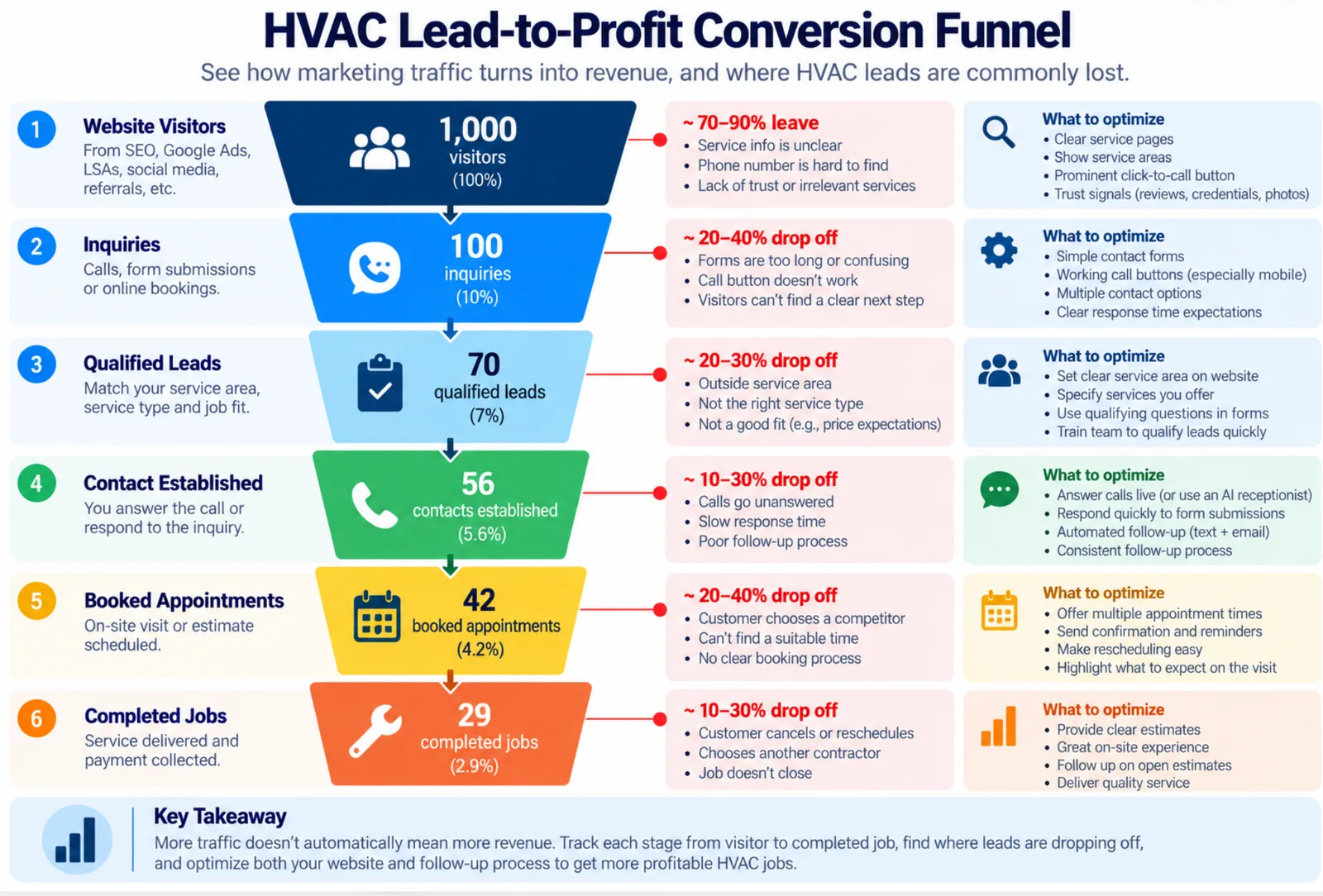
Once you've tracked inquiries through to booked work, you can judge marketing profit only when each inquiry connects to its source, completed revenue, and acquisition cost. A lead count alone won't show whether a channel is producing jobs your business can sell and complete.
A useful HVAC CRM tracking setup keeps each inquiry's details on one lead or customer record, from the first call through the sale. Capture the original channel and campaign, attributable marketing spend, contact attempts and outcome, appointment status, job completion, and revenue collected. When marketing and dispatch data connect to that record, you can trace what happened after someone called rather than relying on disconnected reports. None of that works if the site is not tagged, and only 11% of the contractor sites in our HVAC website tech stack study use call tracking.
Keep each stage distinct. A valid inquiry may not be reachable, a reached caller may not book an appointment, and a booked appointment may not result in a completed job. Those distinctions make HVAC lead qualification more useful and show where potential work is dropping out of your HVAC sales pipeline. Our guide to why HVAC websites lose calls shows how to tell website friction from missed calls and slow follow-up.
Record a clear disposition for each inquiry:
No answer: Your team didn't reach the person.
Out of area: The requested service falls outside your territory.
Duplicate or spam: The inquiry isn't a new sales opportunity.
Declined estimate: The customer received an estimate but didn't proceed.
Won job: The customer accepted the work. Track completion and collected revenue separately.
Exclude duplicates, spam, and existing-customer calls from new-lead calculations, but don't erase them from your business records. Repeat work can still generate revenue, and keeping it visible helps you distinguish new customer acquisition from sales to people who already know your company.
Use consistent definitions when comparing channels, and show the denominator behind each rate:
Contact rate: Reached valid inquiries divided by all valid inquiries.
Booked-job rate: Booked appointments divided by valid inquiries.
Cost per booked job: Channel spend divided by appointments booked.
Customer acquisition cost (CAC): Attributable channel spend divided by new customers won.
Completed-job revenue: Collected revenue from completed work, reported by channel and job type.
"Cost per booked job" can mean different things in different reports. Here, the denominator is appointments booked. To measure spend per completed job, divide by completed jobs and label that result separately. Without clear definitions, a channel can appear stronger or weaker simply because reports measure different stages.
HVAC cost per lead can help you spot changes in what inquiries cost, but it doesn't show whether those inquiries became profitable work. A low-cost social form may pay off if the person answers, books, and completes a job. A cheaper source can also consume staff time when many inquiries go unanswered or come from outside your service area. Compare lead quality with sales outcomes, not inquiry price alone.
HVAC ROAS, or return on ad spend, has a similar limitation. Revenue divided by ad spend shows the revenue associated with advertising, but leaves out labor, equipment, overhead, and profit margin. When gross profit by job is available, compare it with acquisition cost as well as revenue. If you only have revenue, make that limit clear rather than treating revenue as profit. HVAC customer acquisition cost is more useful when it reflects new customers who completed work, not every inquiry or appointment.
Cancellations and uncompleted appointments affect what a channel ultimately produces. A source may generate many booked visits but fewer completed jobs after cancellations, no-shows, or estimates that don't convert. Break results out by channel and job type, too. A replacement project and a smaller repair can have very different revenue and gross profit, so combining them may hide which source brings in the work you want.
Published channel figures can offer context, but the methodology behind the ranges below is unspecified. Market, season, conversion definitions, and job mix may make them incomparable, so treat them as directional estimates rather than targets or promises:
| Channel | Reported conversion rate | Reported cost per customer |
|---|---|---|
| Local Services Ads | 15-25% | $50-$150 |
| Google Ads | 5-10% | $100-$300 |
| Social ads | 2-5% | $75-$200 |
| Organic search | 20-30% | $25-$75 |
| Referrals | 40-60% | $10-$30 |
Your own results are a stronger basis for budget choices when you use consistent definitions and compare similar periods. Review spend alongside contact and booked-job rates, completed revenue, and CAC, while accounting for seasonal demand. Impressions, clicks, and raw lead counts can explain activity, but they don't prove that the work was profitable.
One competitor's published guidance suggests $500-$1,000 per month as a paid-search starting budget and recommends tracking cost per booked appointment. That is one suggestion, not a required spend or guaranteed benchmark. Your suitable test budget depends on your service area, target lead volume, likely cost per qualified lead, booking rate, and appointment capacity. Increase spending only when your tracking shows that additional demand can produce profitable completed jobs.
A practical review separates measured outcomes from gaps in your tracking. If calls aren't tied to appointments, or appointments aren't tied to completed jobs, lead volume can't establish that a channel is profitable. Improve the tracking before increasing spend, especially when comparing HVAC sales lead generation across channels. The least expensive inquiry may not be the best source of booked, completed work.
A useful report connects channel-level spend with valid inquiries, contact outcomes, appointments, completed jobs, collected revenue, and CAC, with job types shown separately. This makes it easier to compare marketing costs with business outcomes and decide where your next dollar should go.
How Do You Choose an HVAC Marketing Partner?
With those results in view, choose an HVAC marketing partner based on how well its plan fits your business, tracks results through to booked jobs, and leaves you in control of the assets you pay to build. A polished presentation or a promise of more leads isn't enough. You need clear priorities, a useful definition of success, and an answer about what happens to your marketing assets if the relationship ends. Our guide to how HVAC contractors should judge a marketing agency has five questions to ask on the first call.
The right channel mix depends on your service area, seasonal demand, preferred job types, appointment capacity, and call-handling process. Ask what the partner would prioritize and why. A call-focused website can help convert existing demand, local search can build visibility over time, and paid campaigns can support a specific offer or service area. The plan should connect those channels to your goals rather than treating every option as essential.
Match the approach to your timeline. Paid campaigns can support near-term demand, but ask how they target your service area and what qualifies as a useful call. Google Local Services Ads generally use a pay-per-lead model where the product is available. Eligible businesses may receive a Google screening or verification badge, subject to Google's category, location, and policy requirements (see this overview of Google Local Services Ads). That pricing model can bring direct inquiries, but it doesn't tell you whether callers need your services, book, or become profitable customers.
Local search requires ongoing work and is usually a longer-term investment. Ask what the work includes and what timeline is realistic for your market. Promises of quick organic results without a clear explanation of the work leave out a key part of the decision. For website updates, ask how they're expected to improve HVAC website conversion and how you'll assess the change.
A sound plan spreads demand across channels you can build and control. Organic visibility, paid advertising, referrals or partnerships, and marketing to past customers can each play a role. Shared directory leads may go to three or more local contractors, so ask how the partner would reduce your reliance on them. If a provider promises exclusive leads, get the definition in writing. Clarify whether exclusivity applies to the source, service area, or time period, and how duplicate inquiries are handled. For a side-by-side on those points, see the ranking of HVAC lead generation providers.
Confirm ownership and access for each core marketing asset:
Website and domain: Confirm who registered the domain, who owns the site, and whether you can transfer both if the relationship ends.
Advertising accounts: Check that your company controls the accounts and find out whose payment method is attached.
Tracking numbers: Confirm who controls the numbers and whether you can transfer them without ongoing agency involvement or undisclosed fees.
Google Business Profile: Verify that your business retains ownership and administrator access.
Ask who created each asset and what happens to the site, data, and phone numbers when the relationship ends. Vague answers leave you at risk of paying for marketing infrastructure that you can't access without the provider. Our guide to choosing an HVAC web design agency covers website and domain ownership in more detail.
Reporting should connect each inquiry to a business outcome. Ask how calls and forms are tied to their source, qualification, booked job, and HVAC customer acquisition cost. A useful report separates impressions and clicks from raw leads, qualified calls, and booked work. It also explains how missed calls and duplicates affect totals, and which call and booking records you can access.
Lead volume can look strong even when the schedule is empty. Several form submissions, for example, may be duplicates or come from outside your service area. Find out how the partner classifies those cases and whether you can see which inquiries became jobs. If reporting stops at visibility or total leads, you can't judge what the marketing produced.
A good partner will tell you when more spending is the wrong move. Before increasing your budget, check whether your team answers calls, follows up on unbooked inquiries, has appointment capacity, and records lead outcomes. More traffic won't fix weak HVAC lead follow-up. If calls go unanswered or estimates sit untouched, improve those processes before paying for more inquiries.
These questions can help identify the bottleneck:
Call handling: How are missed calls identified, and what follow-up happens when a caller doesn't book immediately?
Capacity: Can your team take on the type and volume of work the campaign is meant to generate? If the answer depends on adding a technician, check current HVAC technician pay and annual job openings before you plan the hire.
Lead records: Can you see which inquiries were qualified, booked, duplicated, or left unresolved?
Budget decisions: What evidence would justify increasing spend, and what should be addressed first if booked jobs remain low?
A credible partner can explain its plan, its limits, and what evidence would change its recommendation. If your budget is limited or follow-up is inconsistent, a smaller plan or stronger call handling may be a better first step than expanding campaigns. Choose a partner that ties its work to booked jobs and leaves you with assets and data you control.