
Turn HVAC Leads Into Profitable Maintenance Plan Members
· Updated November 9, 2026

Founder, Honest HVAC Marketing Agency
Digital marketer since 2013. Runs every account himself.
Copies the link to this page
Introduction
Honest HVAC Marketing Agency's guide to turning HVAC leads into maintenance plan members starts with one point: a maintenance-plan lead isn't profitable just because someone fills out a form. To turn HVAC leads into maintenance plan members, make the offer specific, route each inquiry to the right follow-up, and measure enrollments against what it costs to acquire and serve them.
A spring tune-up ad, a recent repair, and a property manager planning service call for different messages and next steps. The channel comparison below includes reported estimates such as $50-$90 per lead for Google Local Services Ads, but those figures aren't forecasts. What matters is whether your team can respond promptly, book suitable work, and deliver the plan terms you advertise.
HVAC Maintenance Plan Key Takeaways
- State plan pricing, included visits, coverage, exclusions, renewal terms, and booking steps plainly.
- Match each campaign to the prospect's need, from planned tune-ups to commercial property maintenance.
- Separate urgent repair inquiries from prospects considering scheduled maintenance.
- Send each ad or referral to a focused page with a clear response path.
- Respond promptly, explain plan terms, and confirm enrollment before counting a member.
- Track leads through contact, booked visits, and enrollments to find where prospects drop off.
- Compare acquisition costs with member contribution, renewals, cancellations, and service costs.
What Makes a Maintenance Plan Offer Worth Joining?
A maintenance plan earns enrollment when customers can see what service they’ll receive, when it’s due, and what it costs. A clear offer can help you attract new prospects without promising that equipment won’t fail or that every repair will cost less.
Customers want heating and cooling systems checked before peak-season demand, a schedule that’s easy to follow, and a simple way to arrange service. An HVAC tune-up addresses those needs when customers know what each visit includes, which systems it covers, and how repairs are priced separately.
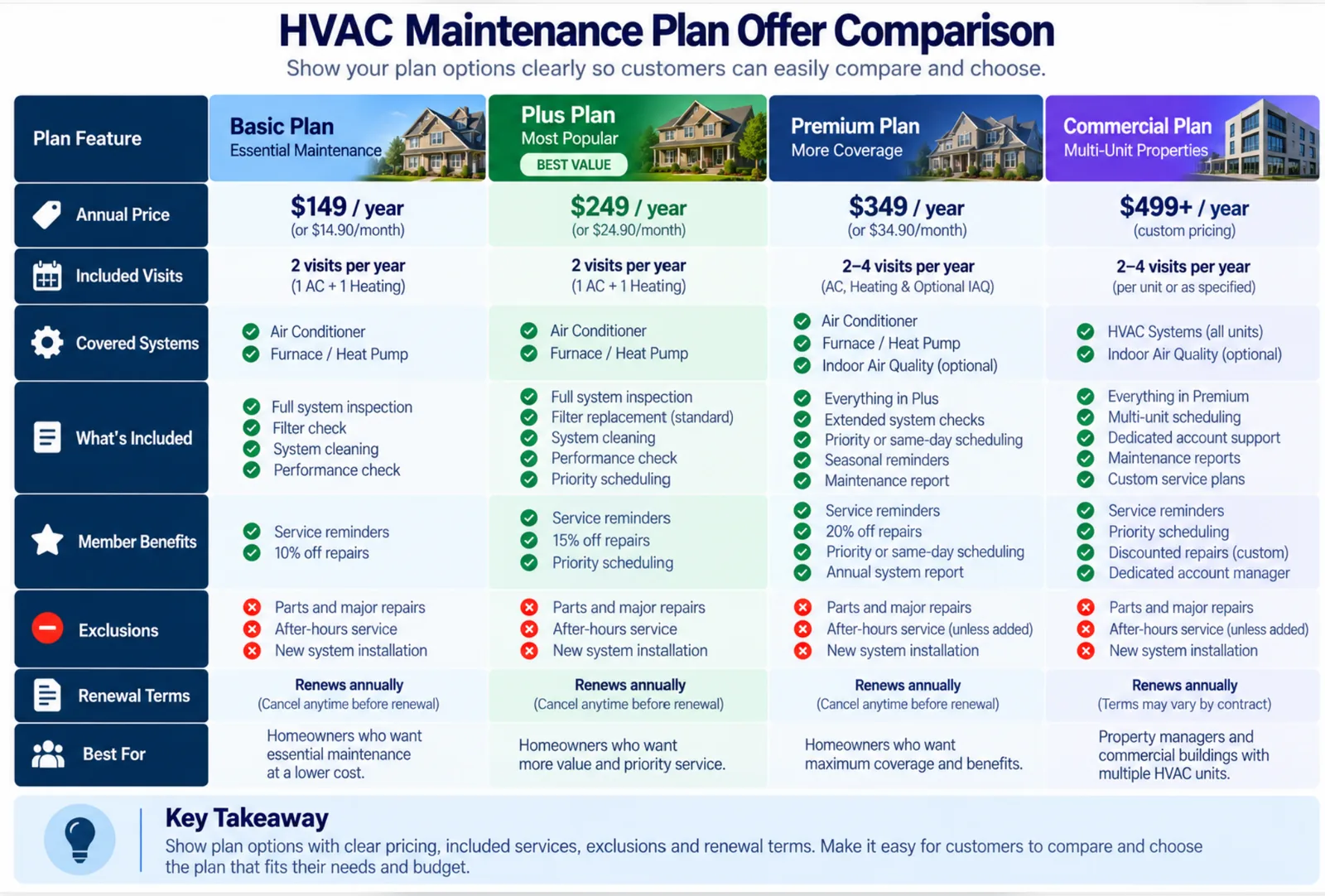
Make every benefit specific enough to compare. State the included visit count, covered systems and seasons, and work performed at each visit. Clarify whether parts, repairs, and after-hours calls cost extra. If members receive priority scheduling or appointment reminders, explain the terms and any limits rather than implying guaranteed availability. Maintenance plan renewal reminders can help customers stay on schedule, but only if your team can send them reliably.
A small number of tiers can serve different budgets without making the choice harder. A basic option might cover scheduled maintenance, while a higher tier could add another visit or a defined scheduling benefit. Show the price and coverage difference plainly, and include an added feature only when it improves the service. If your business doesn’t have written plan terms or tier prices, don’t present hypothetical features as existing benefits.
A free or low-cost starter membership can give prospects a way to try your service before committing to an annual plan. Housecall Pro’s HVAC service plan template describes a free option with seasonal reminders, digital maintenance records, promotions, and a follow-up check-in. This approach works only if your team can deliver those benefits and follow up consistently.
Savings should be easy to verify. Compare the annual fee with the actual cost of buying the included visits separately, then state what the plan excludes. A predictable annual cost can make routine service easier to budget for, but membership doesn’t guarantee lower repair bills, fewer breakdowns, or longer equipment life. Inspection findings may lead to separately priced repairs, and maintenance can’t prevent every failure.
Peace of mind comes from knowing when service is due and how to arrange it, not from fear-based claims. Clear HVAC maintenance agreements distinguish scheduled upkeep from an unlimited repair contract. The value also depends on equipment condition and service history, so describe only work your crew can verify.
Before enrollment, make the offer easy to assess:
Price and billing: State the fee and billing frequency.
Coverage: List included visits, covered systems, seasons, and exclusions.
Terms: Explain renewal and cancellation conditions.
Booking: Describe how customers schedule service and ask questions.
This clarity makes HVAC maintenance plan marketing more useful to prospects because they can judge the offer before speaking with a salesperson. HVAC recurring revenue depends on a service customers understand and choose to renew. For recurring revenue for HVAC companies, focus on a plan your crew can deliver consistently and customers can explain in plain language.
How Do You Build a New-Lead Campaign Funnel?
With the plan offer clearly defined, HVAC maintenance plan campaigns work best when the response path and follow-up match each prospect’s needs. Measure success by suitable memberships booked and the cost to acquire them, not by impressions or a pile of unqualified inquiries.
Start with what each audience is likely to need next. Homeowners preparing to use their air conditioning, customers who recently paid for a repair, and property managers planning service for commercial equipment need different enrollment paths. Reach them through local search, paid ads, referrals or partnerships, and outreach to past customers. The right mix depends on your service area, technician capacity, and ability to respond promptly.
Separate urgent heating, ventilation, and air conditioning (HVAC) searches from planned maintenance demand. Someone seeking emergency repair needs a fast route to service. A homeowner planning ahead has time to compare tune-ups and maintenance plans. Use distinct keywords, bids, and messages for each intent. A repair call isn’t automatically a membership lead, so handle the immediate need before raising enrollment.
A timely offer gives planned-service prospects a reason to act. HVAC seasonal marketing might feature a spring air-conditioning tune-up, a fall furnace checkup, an allergy-season indoor air quality service, or a prepaid annual maintenance plan. Make clear whether the offer covers one visit or starts an ongoing membership, and keep its terms consistent with the plan.
Shoulder seasons can help you build demand before extreme weather puts pressure on customer attention and technician schedules. One budgeting option is to reserve 5-10% of summer and winter deposits for advertising during later shoulder seasons. Treat that figure as a planning choice, not a guaranteed return. Tie each promotion to a relevant service and a genuine booking window rather than manufacturing urgency. Our guide to seasonal HVAC promotions covers matching offers to local demand.
Send each ad or referral to a focused landing page that matches its audience, seasonal need, and offer. Explain what the prospect receives, how the visit relates to the maintenance plan, who qualifies, and what happens after they respond. Provide a direct path to request service or ask about enrollment. A generic homepage can leave visitors hunting for the offer or trying to determine whether their location and equipment qualify. Our guide to HVAC website features covers the forms, call buttons and pages that give that offer somewhere to land.
Keep the inquiry form brief but useful for routing and follow-up. Collect:
Contact details and ZIP code or service area.
Equipment or service needs.
Whether the request is urgent or planned.
Tell prospects what happens after submission and when to expect a response. Capturing intent at intake keeps urgent repair requests from sitting in the same queue as prospects considering future maintenance.
Follow up promptly with a personal response that acknowledges the offer and the prospect’s stated need. A generic confirmation alone won’t move the conversation toward a booked visit or membership discussion. Connect campaign and inquiry records to see which audiences, offers, intents, and sources produce enrolled members, then compare acquisition costs with booked outcomes. If follow-up is slow, the problem can look like a website problem. Our look at why HVAC websites lose calls shows how to tell the difference.
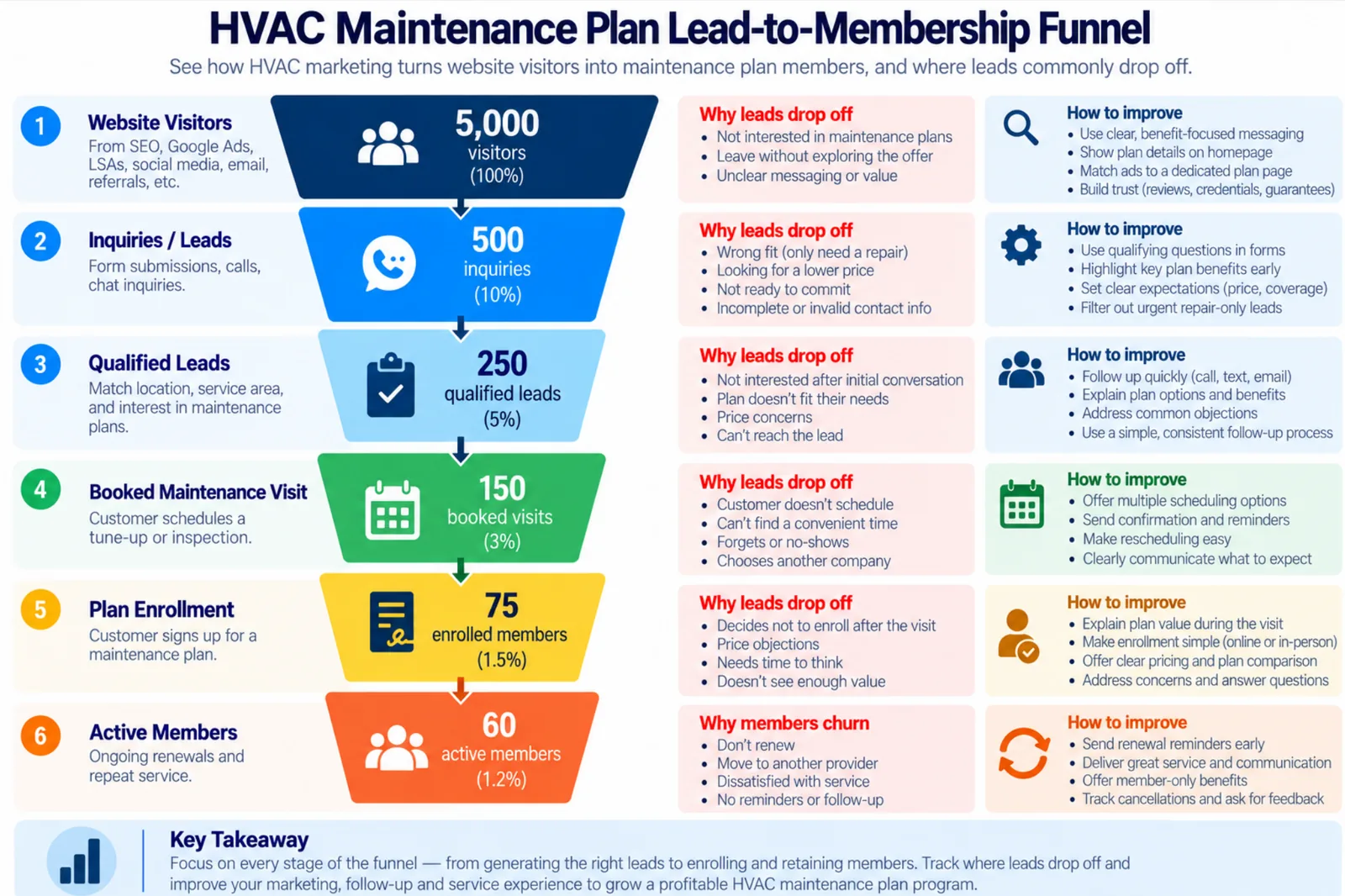
Strong maintenance plan sign-up campaigns also fit how your business operates. Choose channels you can manage well, such as local search, paid ads, or a call-focused website, and recognize when another channel or provider may be a better investment. HVAC lead generation becomes useful evidence for HVAC marketing when you can trace inquiries to booked jobs or memberships and see what they cost. That’s the practical measure for HVAC maintenance plan leads and HVAC maintenance plan marketing.
Which Channels Fit Your Market and Timeline?
The right HVAC marketing channel depends on when you need calls, what homeowners are searching for, and how quickly your team can respond. Google Local Services Ads (LSAs) and Google Ads reach people already looking for HVAC help. Facebook ads for HVAC can introduce a maintenance plan before a homeowner needs service, while HVAC SEO and your Google Business Profile (GBP) support local visibility over time.
Competitor-reported figures can help you compare options, but they aren’t forecasts. PipelineOn reports lead-cost estimates, The Builders Agency reports possible timing for paid campaigns and local SEO, and Vida estimates Map Pack click share. Competition, service-area coverage, the offer, and follow-up all affect results. Use these figures as planning inputs, then compare them with your own qualified inquiries, booked jobs, and enrolled members.
Here’s how those channels compare:
| Channel | Reported cost or reach | Reported timing | Best fit |
|---|---|---|---|
| LSAs | PipelineOn estimates $50-$90 per lead. | The Builders Agency says paid ads and LSAs may generate calls within 1-2 weeks. | Near-term calls from homeowners searching for local HVAC help. |
| Google Ads | PipelineOn reports $104 per lead for blended Google Ads and $72 for Performance Max. | The Builders Agency says paid ads may generate calls within 1-2 weeks. | Specific service searches tied to a relevant local landing page or maintenance-plan offer. |
| Meta/Facebook | PipelineOn estimates $8-$20 per lead. | No timing estimate is provided here. | Introducing your plan to local homeowners before they're actively searching. |
| Local SEO | PipelineOn estimates $10-$30 per lead. | The Builders Agency says meaningful results typically take 3-6 months. | Building visibility over time, beyond a short campaign. |
| GBP | Vida estimates the local Map Pack receives 60-70% of clicks. | No predictable paid-lead cost or launch timing. | Helping homeowners compare nearby contractors. |
Every figure in the table is a non-guaranteed estimate reported by the named company. Vida’s click-share estimate isn’t a universal forecast, and GBP should be evaluated by local visibility rather than paid-lead economics.
Google LSA for HVAC can help you test near-term demand, but eligibility, service-area coverage, and prompt call handling matter. HVAC Local Services Ads won’t turn every inquiry into a booked job, especially if your team can’t answer or schedule quickly. Competition and coverage can also affect lead volume.
When the search, ad, and landing page match, Google Ads works best. Send someone searching for a specific service to a relevant page, not a generic homepage. Track qualified inquiries and booked memberships rather than clicks or raw lead totals.
Meta can suit HVAC maintenance plan campaigns when homeowners need to understand the offer before they’re ready to search. Explain the plan plainly and follow up quickly. A low-cost form submission doesn’t prove likely membership sales, so compare the cost of enrolled members with search-channel results.
As a longer-term investment, Local SEO isn’t a source to count on for immediate calls. Keep your GBP details accurate, update the profile, respond to reviews, and support it with location-specific service pages. These steps help nearby customers evaluate your business, but they don’t set a launch date for results.
Your HVAC marketing mix should reflect local demand and your team’s capacity. Paid search or LSAs can test near-term demand, Meta can introduce an offer, and local search can support sustained discovery. If calls go unanswered or follow-up is delayed, added traffic may create waste instead of profitable memberships. If you would rather buy leads than build channels yourself, Honest HVAC Marketing Agency also sells exclusive HVAC leads that go to one contractor only.
A provider’s strengths matter, too. A specialist in local SEO, Facebook ads, and call-focused HVAC website design should be candid if another channel is a better fit. Before using HVAC campaign cost per lead to judge performance, confirm that you own the assets built for your business:
Your website and domain.
Your ad account and tracking number.
Your Google Business Profile.
Use booked-job and acquisition-cost results to assess channel fit, not impressions alone.
How Do You Turn Inquiries Into Enrolled Members?
Once those channels generate inquiries, an HVAC maintenance plan inquiry becomes a membership when you respond promptly, explain the terms, and complete the enrollment steps. Respond to new inquiries as quickly as your operation can manage, and measure contact and enrollment rates by response-time range. A commonly cited lead-response study reported much higher contact odds for responses within five minutes than for responses after 30 minutes, but the result should be treated as a general benchmark rather than an HVAC-specific forecast (source). A named team member should own each inquiry so HVAC maintenance plan leads don't sit unanswered while everyone assumes someone else will call.
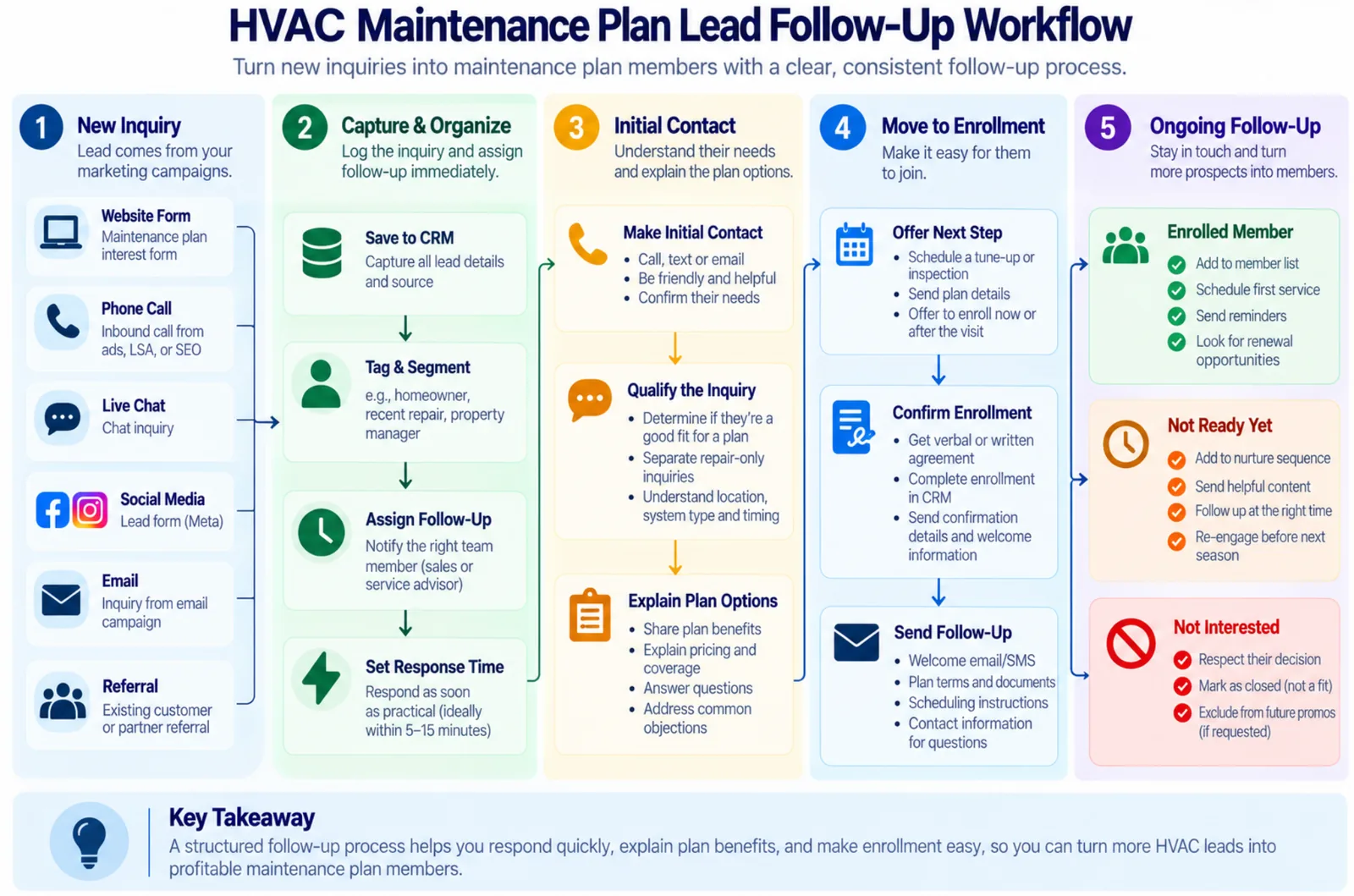
Make the first call about why the customer reached out and what happens next. Ask whether they need routine maintenance, recently installed a system, or have another service need. Explain how membership fits and offer enrollment or a service appointment. If they're busy, agree on a callback time and confirm it by email. The first conversation should establish a useful next step, not rush the customer into a pitch.
Before asking for a commitment, explain the plan in everyday language. Your HVAC maintenance agreements should make these terms clear:
Visits and timing: How many maintenance visits are included and when they're scheduled.
Repairs and discounts: Which repairs, if any, are included and what discount applies to additional work.
Service access: Whether members receive priority scheduling or emergency service, and what those terms mean in practice.
Price and renewal: What the customer pays, when the plan renews, and how cancellation works.
Eligibility and extra charges: Which systems qualify and what the customer may pay beyond the plan fee.
Be precise about the difference between maintenance and repair. A plan may cover inspections or tune-ups without covering parts or corrective work. If that distinction is buried, an introductory price can create expectations the agreement doesn't meet.
A Housecall Pro sample agreement offers one example, not a market-wide price recommendation. It lists $175 per year or $16 per month for two maintenance visits, a 15% repair discount, emergency service, and priority scheduling. Compare those benefits with your labor, travel, and service costs before setting your price. An HVAC service plan template can help organize the offer, but your actual terms should reflect the service you can deliver profitably.
Calls and emails play different roles in follow-up. Use calls to answer questions, understand concerns, and invite a clear decision. HVAC email marketing can recap the proposed plan, price, inclusions, exclusions, and enrollment steps. If someone needs time, ask permission to follow up and agree on a date. That makes maintenance plan sign-up campaigns more useful than a stream of vague reminders.
When a customer agrees, close the loop before counting them among your maintenance plan subscribers. Confirm the selected plan, contact and property details, payment or authorization requirements, expected confirmation, and maintenance scheduling. Enrollment isn't complete until all required steps are satisfied. If the customer declines or postpones, record the outcome and follow up as agreed.
A new system installation is a natural time to offer ongoing maintenance, but mentioning a plan doesn't mean the customer has enrolled. Confirm their decision and complete the same steps. Clear terms and dependable follow-through support HVAC customer retention beyond the first conversation.
How Do You Measure Campaign Profitability?
After tracking enrollment and follow-through, campaign profitability depends on whether maintenance plan subscribers generate more contribution than they cost to acquire and serve. A high lead count or low HVAC campaign cost per lead doesn’t show whether the campaign is working. Track prospects from inquiry to enrollment, then compare acquisition costs with the value members generate over time.
Consistent definitions make results comparable across campaigns and reporting periods:
Lead: A valid inquiry from a potential customer.
Contacted lead: A prospect who has had a two-way conversation with your team.
Booked visit: A scheduled appointment, whether or not the customer attends.
Enrollment: A person who agrees to the maintenance plan.
For each stage, divide attributable campaign spend by the number of leads, contacted leads, booked visits, or enrollments in the same reporting period. Include labor and agency fees when they’re part of your investment, and state what you’ve excluded. Few prospects answering or booking can make enrollments expensive. Tracking cost per contacted lead, booked visit, and enrollment reveals where prospects drop off.
Reliable HVAC marketing attribution connects an inquiry to a completed sale. Your customer relationship management (CRM) system should capture lead source, campaign, first-contact date, contact status, booked visit, completed service, enrollment, and membership start date. Use consistent Urchin Tracking Module (UTM) parameters on campaign links, preserve them through form submissions, and record call sources so phone leads appear in the same picture. For the full lead-to-job tracking setup, see our guide to HVAC lead generation strategies.
Enrollment is only the start of the financial picture. Compare acquisition cost with member contribution, not gross revenue alone. Track plan payments, renewals, cancellations, and related service revenue, then account for the cost of included visits and discounts. Recurring revenue for HVAC companies can look strong in a sales report while losing money if service delivery and acquisition expenses exceed what members pay.
A useful report covers the full funnel and states its measurement window:
Leads, contacted prospects, booked visits, attended visits, and enrollments.
Conversion rates between stages and total cost per acquired member.
Monthly or campaign cohorts, meaning groups of customers acquired during the same period.
A new cohort may show early enrollments, but it hasn’t had time to demonstrate HVAC customer retention. Compare cohorts as renewals come due. Until then, describe observed results rather than presenting retention-based profitability projections as proven.
Industry figures can offer context, but they aren’t targets or verified outcomes for your campaign. Competitor-reported, unverified benchmarks include maintenance-plan member lifetime value of 2.4-3.1 times that of one-time customers, automated-reminder booking rates of 15-25%, renewal rates 60-70% higher, and email returns of $36 per dollar spent. Market, audience, offer, and measurement methods can all affect comparisons. Calculate member lifetime value, reminder booking rates, renewal rates, and email returns from your own cohorts using consistent definitions and a stated observation period.
Maintenance plan renewal reminders may prompt action, but broad booking and renewal statistics aren’t your acquisition cost or conversion rate. Label each result as measured, estimated, or benchmarked, and include campaign dates, market, offer, included spend, lead count, enrollment definition, and observation period. That context keeps HVAC recurring revenue claims tied to observed results rather than assumptions.
HVAC Maintenance Plan Campaigns for New Leads FAQs
These FAQs cover practical decisions for HVAC maintenance plan campaigns for new leads, including channel selection, offer design, and lead follow-up. They also address how to tell whether calls become booked work and which costs matter to your business.
1. How Should New-Lead Offers Differ From Customer Offers?
New-prospect offers should make joining a maintenance plan feel low-risk by clearly stating what’s included, what it costs, and how it can help protect their equipment. An introductory offer can lower the barrier without asking for a large commitment before the value is clear. For existing customers, frame an offer as a loyalty reward or an add-on to a new system purchase. One contractor advertises about 30% savings on an annual plan bundled with a new system; that’s an example, not a typical or guaranteed discount. Easier scheduling can add convenience, but only promise an arrival window you can meet.
2. When Should New-Lead Campaigns Promote Maintenance Plans?
Test HVAC seasonal marketing in spring and fall, using March and September as starting points rather than fixed dates. Seasonal service reminder campaigns may reach homeowners when preventive maintenance feels timely and your team has room for new members, but local climate and booking patterns should guide the schedule.
Treat market figures as claims to verify: one source reports that 30% of homeowners schedule preventive maintenance and that shoulder-season leads may cost 20-40% less than peak-season leads. Compare inquiry costs and enrollment rates across your own seasons before expanding. Lower costs matter only when you can convert leads and serve the members.
3. Should HVAC Ads Target Homeowners or Property Managers?
Target homeowners when your crew can respond quickly in nearby neighborhoods. Center the ad on dependable comfort and keeping heating and cooling equipment in good shape, with appointments that fit household routines. Make the next step simple: request a maintenance-plan quote or book a visit.
Property managers are a better fit when your service area and dispatch capacity can support work across multiple properties. Emphasize predictable costs and smooth coordination with tenants and staff. If your operation is built around individual household visits, put your ad spend toward homeowners.
4. How Can You Retarget Leads Who Didn’t Enroll?
Follow up with interested prospects only through channels they agreed to receive. HVAC email marketing or a brief phone call can recap plan coverage, answer a question, or connect enrollment to a seasonal need. Stop contact as soon as someone opts out.
With valid advertising consent, you can use eligible leads in Meta or Google audiences for a simple reminder or seasonal offer. Limit ad frequency, provide a clear opt-out where applicable, and exclude people who enroll. Measure HVAC customer reactivation by completed memberships, not clicks.